

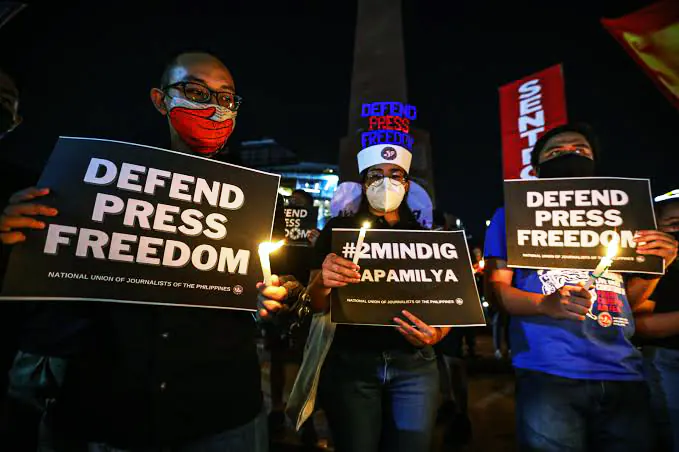
“THE truth may be suppressed, but it cannot be buried forever,” so goes an anonymous adage.
The recent arrest of Philip Lustre, who they call a controversial writer who has written controvertible essays on confounded (to some) issues, was not surprising. There may be more Lustres to come and he was made a model, like a foghorn to others in the industry.
Here, in the Philippines, where democracy has been won through extraordinary sacrifices and where the freedom of the press remains a hard-earned right, the arrest, intimidation, or silencing of a journalist raises a question that goes far beyond the fate of one individual: Can those in power suppress the truth simply by punishing the person who dares to reveal it?
The answer, history tells us, is no.
SILENCE THE MESSENGER
A journalist can be arrested. A reporter can be threatened. A broadcaster can be taken off the air. A publication can be pressured into silence. Even the most courageous truth-teller can be deprived of liberty, subjected to relentless legal battles, or made to pay a devastating personal price for exposing wrongdoing.
But the truth is another matter.
It does not live exclusively in the journalist who reports it. It lives in the documents that substantiate it, the witnesses who remember it, the citizens who have seen its consequences, and the collective conscience of a people who refuse to be deceived.
Silence the messenger, and another may take up the story. Close one newspaper, and other voices may carry the facts. Suppress one revelation, and the very attempt to conceal it may provoke even greater scrutiny.
The arrest of a journalist does not erase the truth. Sometimes, it only draws greater attention to what someone desperately wants hidden.
THREATS TO PRESS FREEDOM
The Philippine experience offers sobering reminders of the price of speaking truth to power. During the martial law years under Ferdinand Marcos Sr., censorship, arrests, and the closure of independent media were among the instruments used to control public information. Yet the truth about repression and abuses survived in underground publications, in the accounts of victims and witnesses, and in the memories of those who refused to surrender their right to know.
The 1986 People Power Revolution demonstrated that a people kept in the dark could eventually find the courage to reclaim their voice.
The return of democracy did not mean that threats to press freedom disappeared. Journalists continued to face harassment, legal intimidation, threats to their lives, and, in the most tragic cases, murder. The killing of journalists, including those covering corruption, politics, and abuses of authority, remains a grim reminder that the pursuit of truth can be dangerous in a society where powerful interests may feel threatened by exposure.
The lesson is unmistakable: When those who expose wrongdoing become the targets of punishment, readers and society must ask not only what the journalist has done, but also what others may be trying to prevent the public from discovering.
Of course, journalism must be governed by accuracy, fairness, responsible reporting, and respect for the law. No journalist should be above accountability, and no allegation should be accepted as fact without credible evidence. But accountability must never become a convenient pretext for retaliation, nor should legal processes be manipulated to punish legitimate investigative reporting or discourage others from asking difficult questions.
PUBLISHING THE TRUTH
A democracy cannot flourish when journalists must calculate the personal cost of every truth they publish. Nor can citizens make informed decisions when information is controlled, inconvenient facts are suppressed, and those who question authority are treated as enemies.
The press is not infallible, but a free press remains one of the public’s most important safeguards against the abuse of power. Its responsibility is not to protect those in authority from embarrassment. It is to serve the public interest by illuminating matters that citizens have a legitimate right to know.
And this is where the responsibility extends beyond journalists.
The public must not be a passive audience, content to accept whatever version of events is handed down by those in power. Citizens must learn to distinguish evidence from propaganda, facts from fabricated narratives, and legitimate criticism from deliberate disinformation. They must defend the right of journalists to investigate and report—even when the revelations are uncomfortable, even when the stories challenge their political loyalties, and even when the truth contradicts what they would prefer to believe.
Because the freedom being threatened is not merely the journalist’s freedom to write or speak. It is the people’s freedom to know, to question, and to hold power accountable.
In the end, those who seek to suppress the truth may succeed in delaying its revelation. They may intimidate witnesses, silence broadcasters, confiscate documents, or force journalists into courtrooms instead of newsrooms. They may even persuade some people to look away.
But they cannot guarantee that every witness will remain silent, every document will disappear, or every citizen will forget.
POWER OF THE TRUTH
Truth has a resilience that power cannot permanently defeat. It can survive censorship, outlive political administrations, and emerge long after those who tried to bury it have left the corridors of power.
A journalist can be arrested and a voice can be muffled. But truth has no prison, no political allegiance, and no expiration date.
And in a democracy, the ultimate question is not how effectively the powerful can silence those who expose the truth. It is how long a nation will allow them to try.
You may arrest the journalist, confiscate the evidence, and silence the microphone. But you cannot arrest an idea, imprison a fact, or gag the conscience of a nation forever. The truth may be forced into hiding, but it will never surrender its right to emerge.
#PhilippineJournalism
#shootthemessenger
#PowerOfTheTruth
#PressFreedom
#PhilipLustre