

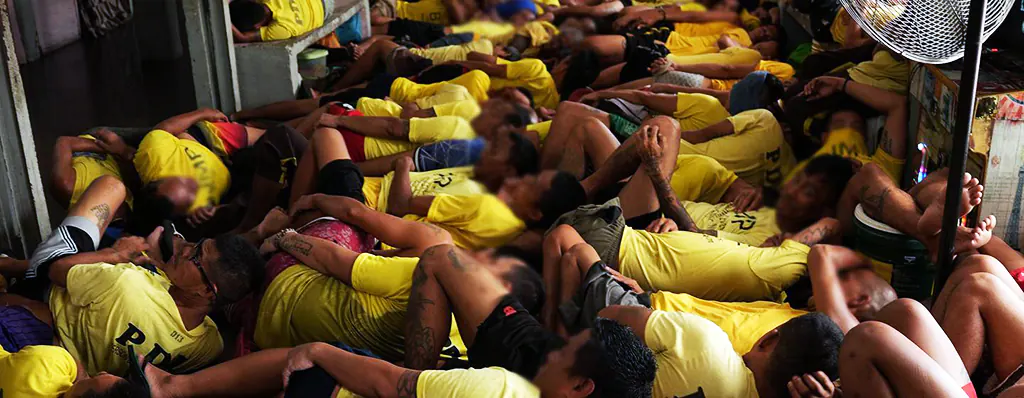
THE Commission on Audit-citing its evaluation of the jail reports in 2025– noted that 341 of 488 jail facilities in the country are beyond systemic overcapacity, ranging from 1 to 2,000 percent, despite the steady improvements being done to ease the load of jail systems and provide more breathing space to the people deprived of liberty (PDLs).
While COA took cognizance of the steady improvement in Bureau of Jail Management and Penology (BJMP) facilities’ congestion rate nationwide, the state auditor still called for continued efforts to address congestion or systemic overcapacity.
In its audit report released on October 28, state auditors observed a four-year decrease in congestion rates from the recorded 367 percent in 2022 to 279 percent in 2025.
“While this positive trend indicates progress in institutional decongestion strategies, the current baseline remains significantly elevated above prescribed humanitarian threshold,” COA wrote.
BJMP currently has 240,307 square meters of cell area for 113,937 persons deprived of liberty (PDLs), falling short of the 295,197 square meters needed to accommodate all inmates during incarceration.
Long-standing overcrowding compromises the BJMP’s statutory mandates under Republic Act No. 6975 and institutional manuals on providing humane custody of PDLs.
Auditors flagged three jail facilities with the largest infrastructure deficit, with Consolacion Municipal Jail (Cebu, RO VII) topping the list at 2,000 percent, followed by Muntinlupa City Jail–Male Dormitory (NCR) and San Mateo Municipal Jail–Male Dormitory (RO IV A) at 1,673 percent and 1,474 percent, respectively.
According to the BJMP annual accomplishment report, implementing the New Good Conduct Time Allowance Act and the Recognizance Act of 2012 helped decongest jails by allowing early release of PDLs through behavioral rehabilitation.
The Bureau’s paralegal program also facilitated coordination with courts to expedite pending releases, which later accounted for the 92,427 PDLs released last year.
It later informed the Commission that 43 construction projects are underway, including expansions of the three aforementioned facilities, and that the number of congested jails is expected to decrease from 341 to 300.
COA said: “…the team recognizes Management’s positive trajectory and will monitor the completion of these infrastructure projects and the continuity of paralegal programs in the next audit cycle.”
BJMP, for its part, agreed to continue current measures to address persistent congestion in its jail facilities nationwide.
BJMP manages city, municipal, and district jails for pre-trial and short sentences.
BuCor Updates
The Bureau of Corrections under the Department of Justice, manages the national prisons and penal farms for sentences over three years.
As of September 2026, the BuCor prisons had 5,182 inmates out of the 17,211 capacity of the facilities or a decline from January’s capacity of 5,291.4 inmates. Its report said that as of September 2026 7,800 PDLs were in confinement.
The biggest population of PDLs was reported at the New Bilibid Prisons at 21,369 or at 39 percent; followed by Davao Prison & Penal Farms at 10,795 or at 21 percent; Iwahig Prison & Penal Farm at 5,064 or 10 percent; Leyte Regional Prison at 4,485 or 9 percent; then San Ramon Prison & Penal Farms at 4,708 PDLs or 9 percent; the Sablayan Prison & Penal Farm at 3,786 or 7 percent; and the Correctional Institute for Women at 2,733 or 5 percent.
Interestingly, the age group with most PDLs was 40 to 59 at 25,125 followed by 22 to 39 years old at 19,611; then 60 up at 6,080 and next 18 to 21 at 730 PDLs. By civil status, the highest number of PDLs were single at 321m262; then married at 17,700 and widowed 1,593.
By population, the highest number of PDLs came from NCR at 10,788; followed by R4 at 8,772; Region 3 at 4,203; Region 10 at 3,944 and Region 5 at 3,450.
The total prison and jail population in the Philippines is around 171,000 to over 188,000 persons deprived of liberty (PDL), depending on recent data splits between national penitentiaries and local jails.
As of mid-2024, the total prison and jail population stood at 171,247 (with about 53,397 housed in Bureau of Corrections [BuCor] national prisons and 117,850 in Bureau of Jail Management and Penology [BJMP] local jails).
A major portion—roughly 65% to 75%—consists of pre-trial or remand detainees awaiting trial or sentencing. The BuCor manages national prisons and penal farms for sentences over three years.
Borgen Project
In a recent blog, the global Borgen Project noted the Philippines’ incarceration system in 2018, as the sixth-highest prison population out of 21 Asian countries.
At its national population in 2019 of 108.31 million people, 215,000 of them were incarcerated or an incarceration rate of about 200 per 100,000 citizens. There are 933 prisons in the Philippines, which it said were mismanaged and overcrowded. Below are five important facts about the incarceration system in the Philippines.
It noted these five facts about the country’s incarceration system:
- Severe overcrowding – Rodrigo Duterte’s win in 2016 vowed to end crime within six months. This promise also included the killing of tens of thousands of criminals leading to the infamous war on drugs and eventually, overcrowded the prisons. Manila City Jail, the largest jail, is split into dorms that safely house 170 inmates. Currently, these dorms house around 500 people. Similarly, a room designated for 30 people holds about 130 in the Quezon City Jail. This severe overcrowding in prisons leads to illness and death tolls in the thousands.
- Pre-trial detainees – According to The World Prison Brief, 75.1% of incarcerations within the Philippines’ incarceration system are pre-trial. In 2018, 141,422 of 188,278 prisoners were pre-trial detainees. Unfortunately, many people are serving sentences without conviction. Pre-trial detention is found in judicial systems all over the world. In countries like the Philippines, people may serve time that outweighs their crimes. On average, prisoners in the Philippines are detained for nine months without being sentenced.
- High death tolls – About 5,200 inmates die yearly at the New Bilibid Prison (NBP). According to Ernesto Tamayo, the hospital medical chief, these deaths are due to overcrowding, dirty living conditions and inmate violence. At a 2019 Philippines Senate hearing, Tamayo said that there were “uncontrollable outbreaks of pulmonary tuberculosis.” In addition to overcrowding, poor living conditions and inmate violence, NBP lacks nutritional food and basic healthcare. On account of these living conditions, Tamayo reports that at least one prisoner dies at NBP each day. Thankfully, politicians and prison employees are working to reduce overcrowding in the Philippines’ prisons. Human rights advocates have also called for the release of vulnerable inmates, hoping to protect them from poor living conditions.
- Vigilante justice – Duterte’s drug war escalated during his presidency. Jobless citizens were recruited to kill anyone suspected of dealing, buying or using drugs. This was one of few ways for some people to make money; many homeless and impoverished people joined the vigilante teams. In 2016, Duterte told the public, “If you know of any addicts, go ahead and kill them yourself.” Together, the Philippines’ police force and unidentified gunmen have killed 7,000 known drug dealers and users since Duterte’s presidency in 2016. The Philippines’ war on drugs has created the belief that extrajudicial violence and murder are necessary to fight crime. But, the Human Rights Watch has turned the narrative around on Duterte; they are publicizing information about the vigilante justice in the Philippines.
- Corruption – In August 2018, the public learned a former mayor may have been released from prison for good behavior. He was originally charged for rape and homicide in 1993. Similar stories of corruption in the Philippines’ prisons continued to emerge. In September 2018, the public learned that a woman was told her husband’s sentence would be shortened if she paid P50,000 ($970). Later that year, senators stated that inmates could “live like kings” for a fee. This information led to further allegations: prison workers and officials were taking bribes to bring and distribute contraband to inmates. The contraband in question included cigarettes, cellphones and televisions. Supposedly, inmates can also pay for personal cooks and nurses. Inmates who cannot afford a better life within the prison are stuck in overcrowded and dirty rooms; these inmates have a higher rate of becoming ill and of death. Now that the corruption has been unearthed, officials are taking steps to weed it out, one prison at a time.
The blog said with increased awareness of the Philippines’ prison system, there is hope that conditions will be improved and vigilante justice will end. It will take time to fix the Philippines’ judicial and incarceration systems. However, with the help of advocacy groups like the Human Rights Watch, a change could come sooner than expected.