

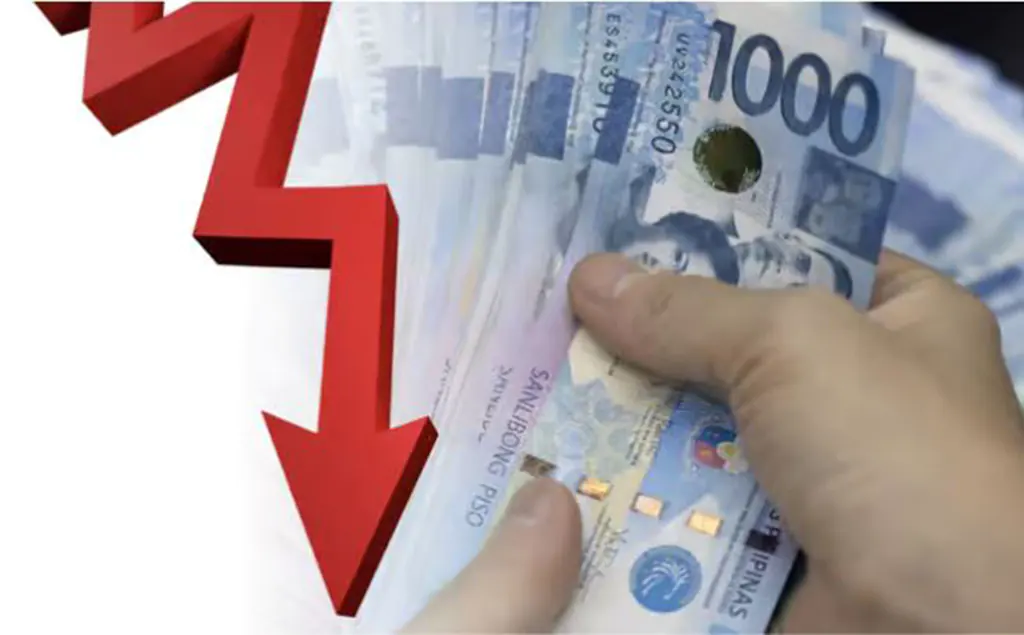
THE Philippine peso dove to its 34th record low against the US dollar on Wednesday amid growing expectations of higher interest rates and renewed volatility in global oil prices.
The country’s currency dragged down by 27.1 percent to P63.361 to $1 from its previous low of P63.09 on Tuesday, data from the Bankers Association of the Philippines showed.
This marked the peso’s 34th record low this year and its fifth so far in October, according to Business World.
Year to date, the peso has weakened by P4.571 or 7.21% from its P58.79 finish on Dec. 29, 2025.
The Philippine peso hit its lowest-ever levels against the US dollar under President Marcos Jr. diving past historic milestones into the P63 to P63.15 per US dollar range in October 2026.
The lowest recorded level of the peso in the past were P56.77 in 2022 (during the first year of Marcos Jr.) and P59+ in 2025, before plunging to new record lows crossing the P63 threshold in October 2026 (such as P63.09 to P63.15 per dollar).
The virtual freefall has been driven by a stronger US dollar, regional currency pressures, rising global oil prices, and broader economic headwinds.
The local currency opened Wednesday’s session slightly stronger at P63.01 per dollar and hit an intraday best at P63. Its worst showing was at P63.373, which also marked the peso’s weakest level on record, beating its previous P63.23 trough on Oct. 16.
Dollars traded dipped to $1.34 billion from $1.36 billion.
Expectations of further rate hikes by the US Federal Reserve and the Bangko Sentral ng Pilipinas (BSP) kept the dollar elevated against the peso, Reyes Tacandong & Co. Senior Adviser Jonathan L. Ravelas told Business World.
“The peso reached new lows on market uncertainty ahead of the BSP policy meeting (on Oct. 22),” a first trader said.
Alyssa Nuñez, a former economist at University of Asia and the Pacific and currently working for a private commercial bank, said that the peso could see brief relief, but not a real rebound against the dollar as the BSP’s rate hike has already been priced in.
“At best, it may slow the decline a bit,” she added.
A survey by the paper showed 20 of 22 economists expect the Monetary Board to raise rates by 25 basis points (bps) for a fourth straight time on Thursday, which will bring the policy rate to 5.25%.
This would match the benchmark rate set in June 2025 and will be the highest since the 5.5% in April 2025. Since April, the BSP has hiked benchmark borrowing costs by a cumulative 75 bps.
Meanwhile, the Fed’s next meeting is scheduled for Oct. 27-28.
“The peso weakened significantly to record lows (on Wednesday) on market jitters after reports emerged that the US recently approved a set of diplomatic negotiators to resume talks with Iran, on the background of renewed geopolitical tensions in the Middle Eastern region,” a second trader said.
A third trader responded by phone that the peso declined as the market responded to Brent crude futures crossing $110 a barrel amid lingering tensions in the Middle East and ahead of the BSP’s policy meeting.
The third trader noted there was limited BSP intervention in the foreign exchange market given the recent decline in gross international reserves (GIR).
“We see minor intervention due to limited reserves. But we are hoping the BSP statement (on Thursday) will be supportive of the peso to avoid a strong climb as well as intervention in the market,” the trader said.
The country’s dollar reserves dropped by 8.3% to $99.997 billion in the nine months to September from $109.06 billion a year ago.
This was the lowest GIR level in three years or since the $98.116 billion logged in September 2023 and marked the seventh straight month that the GIR contracted annually.
For Thursday, the third trader said hawkish sentiment from the BSP may support the peso.
The second trader sees the local unit ranging from P63.20 to P63.45 against the dollar, while the third trader expects it to move between P63 and P63.50.
Call it coincidence, but during Marcos Sr’s presidency, the Philippine peso also dove from P3.91 to %1 in December 1965, when he took office to P18.60 by 1985, when his over two decades of rule ended.
The currency depreciated by about 423% during the dictatorship, driven by mounting foreign debts, economic crises and major devaluations in the 1980s– all conditions besetting our country now.