

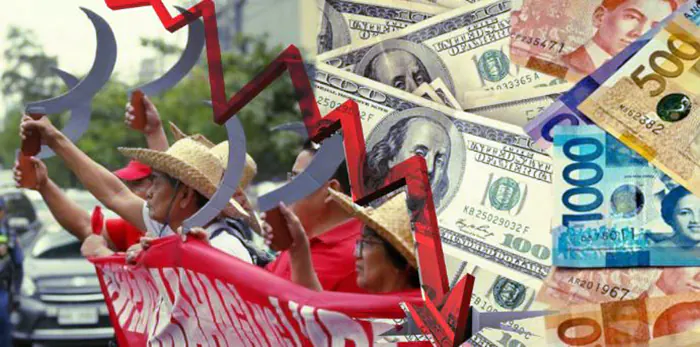
CAPITAL outflows and other factors could further weaken the exchange rate to a point where the Philippine peso could shrink to P65 to $1.
This dire prognosis was made by former Central Bank Gov. Jose Lampe Cuisia Jr. as he stressed the difficult position facing Bangko Sentral Gov. Eli Remolona now.
Cuisia was the 7th CB Governor from 1990 to 1993 when he faced a profound multi-layered financial and institutional crisis– inheriting the volatile fallout of the 1980s debt crisis and an economy heavily disrupted by the aftermath of the December 1989 coup against the Cory Aquino administration, which crippled tourism and investor confidence.
But the most severe crisis, during his term as CB Governor, was structural owing to decades of taking on massive liabilities, open market operations and currency depreciation shocks that accumulated catastrophic financial losses on CB’s balance sheet, making it technically insolvent.
After the peso’s rapid plunge from ₱63 to ₱64 per US dollar, Cuisia told Manila Bulletin on Wednesday that breaching the ₱65:$1 threshold has become “very easy.” It took only eight trading days for the peso to tumble past the ₱64-per-dollar level.
Cuisia was the last governor of the CB before it was replaced by the Bangko Sentral ng Pilipinas under the New Central Bank Act of 1993.
He said that one factor supporting the US dollar is the heightened expectation that the US Federal Reserve (Fed) will once again raise its key borrowing rate by a quarter point as inflation remains high.
Last September, the US Fed raised its key policy rate by a quarter point to a range of 3.75 to four percent. If the Fed raises borrowing costs again, the greenback stands to gain, potentially weakening demand for riskier emerging market (EM) currencies.
The peso snapped its losing streak on Wednesday, Oct. 28, recovering by 14.5 centavos to close at ₱64.025 against the US dollar, from its record low of ₱64.17 last Tuesday, Oct. 27.
According to the Bankers Association of the Philippines (BAP), the local currency opened at ₱64.08, reached an intraday high of ₱63.94, and touched a low of ₱64.18.
Singapore-based United Overseas Bank Ltd. (UOB) said the peso remains under pressure as the Philippines, a net oil importer, continues to bear the brunt of elevated crude prices.
Cuisia acknowledged President Marcos Jr.’s remarks “do not take it with alarm, don’t panic” about the peso’s continued decline against the greenback, particularly after the local currency breached ₱64 per dollar for the first time on record.
Marcos said surging oil prices continued to put pressure on the peso but assured the public that the country has capacity to defend the local currency, citing the country’s foreign exchange (forex) reserves, which he described as “healthy.”
Cuisia echoed the BSP’s stance that it will not step into the forex market unless excessive volatility threatens to stoke inflation. He also pointed out the depletion of the international forex buffer. “They cannot squander,” Cuisia said.
Gross international reserves (GIR) shrank to a three-year low of $100 billion in September due to a contraction in gold holdings, the BSP’s forex operations, and the national government’s (NG) debt servicing.
While Marcos expressed his views, Cuisia insists that BSP must remain independent, although he noted the difficult balancing act that Remolona is currently facing.
“It’s a very tough problem. I wouldn’t want to be in the shoes of Governor Remolona. I’m sure he has sleepless nights,” Cuisia said.
Investment flows also affect the exchange rate, Cuisia said.
“You look at the figures. That’s the unfortunate thing because that also affects the exchange rate. If we had foreign direct investors coming in, we could rely on those dollars coming in,” he said.
Foreign direct investment (FDI) net inflows into the Philippines contracted by nearly a quarter in the first seven months of 2026 to $4.07 billion from $5.35 billion in the same period in 2025, as global geopolitical tensions and slowing domestic growth dampened international risk appetite.
Cuisia added that portfolio investments, or so-called hot money, were leaving the country as foreign investors sold their holdings in the local market and moved elsewhere. Such transactions increase demand for US dollars as investors convert proceeds from peso-denominated assets into foreign currency.
Foreign investors also withdrew more money from Philippine financial assets than they brought in through August, reversing the net inflows recorded a year ago. Renewed tensions in the Middle East rattled investors, prompting them to pull out of EM assets amid heightened exposure to the war.
Last Oct. 22, the BSP raised its key policy rate by an outsized 50 basis points (bps) to 5.5 percent, as the central bank anticipated that inflation would continue to rise over the coming months.
Cuisia hopes the Philippine benchmark interest rate will not return to the 6.5-percent peak recorded in 2024, as the country is also grappling with its mounting debt burden, the Bulletin added.
“We have such a huge debt. So the cost to the government, every time you increase the rate, is so high,” he said.
As of end-August, the NG’s debt stock swelled to a record ₱19.61 trillion as new borrowings and a weaker peso pushed up both domestic and external obligations.