
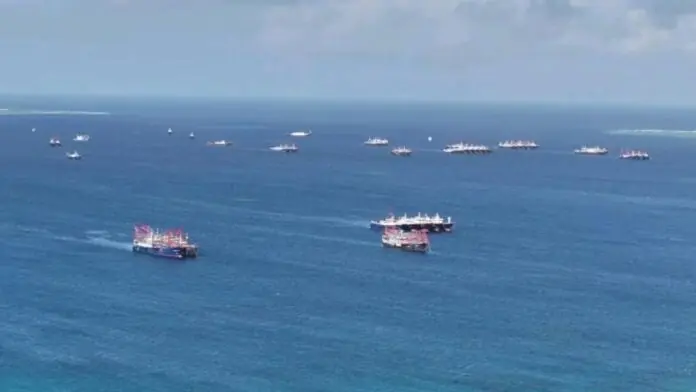
DAYS after the ASEAN Summit, the Armed Forces of the Philippines (AFP) reported an increase in the number of Chinese vessels sailing well within the 200-nautical mile Philippine exclusive economic zone.
According to retired Rear Admiral Roy Vincent Trinidad, 48 Chinese vessels were recorded from November 17 to 23. This was higher compared to the 19 Chinese vessels recorded from November 9 to 16. Trinidad is the AFP spokesperson for the West Philippine Sea.
“Noong ASEAN (Summit), nagpakita sila na konti na ang nilagay nila sa ating EEZ na mga barko,” Trinidad was quoted in a radio interview, even as he assured that the Philippines will continue to monitor foreign vessels in the disputed maritime region via sea-based, air-based, land-based, and space-based monitoring capabilities.
The retired rear admiral likewise cited the contributions of Filipino fisherfolk and seafarers, whom he claimed are providing photographs, realtime videos, and reports of foreign vessel movements, supplementing the military’s monitoring capabilities.
Beijing maintains claim over almost all of the South China Sea which serves as conduit for more than $3 trillion of annual shipborne commerce, including parts claimed by the Philippines, Vietnam, Indonesia, Malaysia, and Brunei.
In 2016, the Permanent Court of Arbitration in the Hague ruled in favor of the Philippines over China’s claims in the South China Sea, saying that it had “no legal basis.”
China has refused to recognize the decision.