

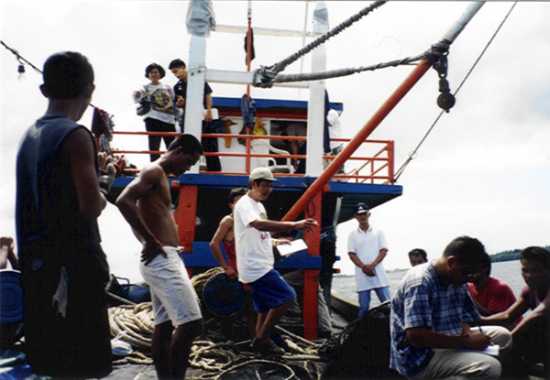
A RENOWNED fisheries scientist asked Philippine authorities to stop commercial fishing in coastal/ municipal waters to allow fishing stocks to recuperate from depletion.
Dr. Daniel Pauly, Pauly, who serves as a board member of Oceana has stayed in the country from 1979 to 1994 while at the International Center for Living and Aquatic Resources Management (ICLARM) now known as WorldFish, said the best way to rebuild and restore overexploited fish stocks is to fish less.
“The only measure which ensures the rebuilding of overexploited fish stocks is to fish less. This applies especially to coastal areas, which are increasingly invaded by huge industrial vessels [worldwide, including in the Philippines]. There is no alternative to this,” said Pauly, a globally recognized fisheries scientist and marine conservation expert.
He has worked in the tropics and developed new methods for estimating fish populations, designing, implementing, and perfecting methods using length-frequency data to estimate fisheries statistics.
Pauly shared his insights in a public lecture organized by Oceana, Quantitative Aquatics, Inc. (Q-quatics), and the National Museum of the Philippines. He explained that while the nature of both freshwater bodies and oceans is forgiving, recovery can only come if people stop the harms they inflict on these natural life support systems.
Oceana Vice President Von Hernandez called on Agriculture Secretary Francis Tiu Laurel and President Marcos Jr. to heed Pauly’s expert recommendation and address the causes of overfishing in Philippine seas.
“For over a decade, commercial fishing interests have held government policy hostage at the expense of our marine ecosystems and small-scale fishers. By failing to stop illegal commercial encroachment inside the 15-kilometer municipal waters, which are waters reserved by law for the small-scale municipal fisherfolk, the government is allowing the collapsing of fish stocks and empty nets to become our new normal. We cannot fix this food security crisis until we put public interest over commercial profit,” Hernandez said.
Dr. Loida Corpus, Executive Director of Quantitative Aquatics, Inc. (Q-quatics), which develops and stewards major global aquatic biodiversity information systems including FishBase, SeaLifeBase, and AquaMaps, affirmed the cause of the problem.
“Commercial sea fishing in northern Europe was born out of the world’s first fishery crisis” (Roberts, 2007, Kindle location 1919), “the 11th-century collapse of freshwater fisheries. Does this history speak to us, as metamoderns, as we stand on the threshold of another, potentially more complex fisheries collapse, this time in our seas?” she said.
Pauly said the decline in fish stocks also hampers the organic capacity of fish to adapt to the impacts of climate change, such as marine heatwaves, coral bleaching, and even stronger El Nino events, threatening the livelihoods of coastal fishing communities further.
“Fish, to a certain extent, can adapt to changes in their ecosystem, and the more fish there are in the water, the more variants there will be that can handle these changes. Small populations are limited in this regard and will have more difficulty adapting. Hence, allowing populations to rebuild from overfishing not only leads to higher sustainable catches, but also to populations that can better handle climate change,” Pauly said.
Pauly cited the work of former Environment Secretary and scientist Angel Alcala as among the best stories of how overexploited stocks were rebuilt over 50 years ago, Business Mirror reported.
“Closing 25% of a reef to fishing resulted in a three- to four-fold increase in fish catch in the remaining 75% of the fisheries area, within just one to two years only. At that time, the Philippines taught the world about Marine Protected Areas. This is a legacy that must not be forgotten,” he said.
He earlier paid a courtesy call with Senator Raffy Tulfo, chair of the Senate Committee on Environment and Natural Resources, as he backed calls for the swift passage of the National Coastal Greenbelt Act, which would help protect mangroves and rebuild fish stocks in coastal areas and communities.
The public lecture drew a diverse, multisectoral audience from the academic and scientific communities, fisherfolk, youth and civil society groups.
Sadly in August 2024, the Supreme Court in (Mercidar Fishing Corp) resolved to affirm a Malabon Regional Trial Court ruling invalidating key provisions of the Fisheries Code (RA8550 as amended by RA10654) restricting commercial fishing within 15-km municipal waters.
Reports from government agencies, lawmakers, and legal groups note that the SC’s affirmation stemmed from procedural lapses and late filings by the Office of the Solicitor General (OSG) on behalf of the Department of Agriculture (DA) and the Bureau of Fisheries and Aquatic Resources (BFAR).
According to the DA– through OSG– it filed a motion for reconsideration in January 2025 to overturn the decision, alongside petitions and interventions from LGUs, fisherfolk groups, and civil society organizations.
In a separate ruling announced in August 2026, the Supreme Court struck down Fisheries Administrative Order No. 266, invalidating mandatory continuous location tracking and electronic catch reporting for commercial fishing vessels on constitutional grounds, which the Inquirer reported prompted warnings from groups like Oceana over enforcement and small-scale fishers.
The decision removed the 15-kilometer boundary that reserved municipal waters for small-scale fisherfolk and allowed commercial vessels to operate in waters seven fathoms (about 12.8 meters) or deeper.
Current reality is that municipal fishermen have very little, if any, catch daily unless they go to deeper waters, which most of their boats can’t manage.