

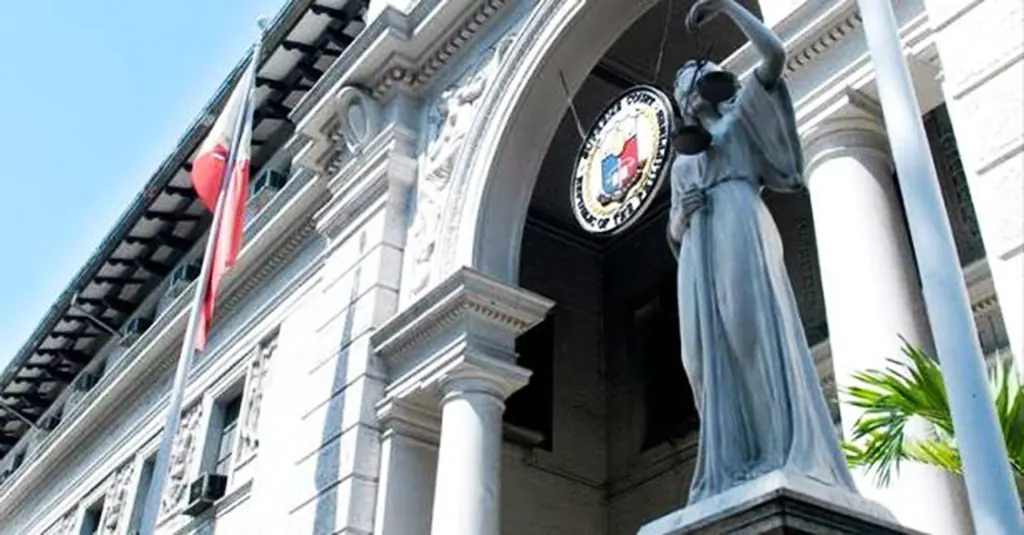
AFTER completing the amendments to the 1935 Revised Penal Code for criminal cases, the Supreme Court has amended provisions in its internal rules on administrative cases involving judges, officials and personnel (including lawyers) of the judiciary by raising suspensions and thresholds and increasing penalties thereto.
In a 15-page ruling in the case of the Office of the Court Administrator (OCA) vs. Manila Regional Trial Court Branch 49 Presiding Judge Juliet Azarraga Chanyongco, the Court revised Rule 2 Section 3 ( e ) of the Internal Rules of the Court.
The current internal rule states: “The Court en banc shall act on the following matters and cases where the penalty recommended or to be imposed is the dismissal of a judge, official or personnel of the judiciary, the disbarment of a lawyer, the suspension of any of them for a period of more than a year, or a fine of exceeding forty thousand pesos. “
“We amend the foregoing provision to increase the threshold for suspension from one year to three years and the threshold for fine from P40,000.00 to P200,000.00,” the SC said.
It explained that increasing the threshold would allow more administrative cases to be processed and resolved through streamlined procedures, thus, reducing the burden on the dockets of the Court en banc and allowing expedited resolution for parties, reported Business Mirror.
The latest amendment of the Court’s internal rules stemmed from the complaint filed by the Office of the Court Administrator (OCA) against Chanyongco, in her capacity as the former Presiding Judge of Branch 53, Metropolitan Trial Court (MTC), Caloocan City.
The OCA charged the judge with gross misconduct constituting violations of the Code of Judicial Conduct, gross ignorance of the law, and gross inefficiency based on the results of a judicial audit conducted in Branch 53.
The judicial audit was done in connection with the judge’s promotion from the said court to Manila RTC Branch 49, and to verify the information received by the OCA regarding the alleged irregularities and inefficiency she committed. Based on the judicial audit, Chanyongco committed delays in the arraignment of several accused.
The audit team found that the hearing of 359 arraignments were reset several times, but eventually never pushed through.
The judge also motu proprio routinely set cases for clarificatory hearing to delay the resolution of her cases; caused delay in the resolution of cases when she set even a mere formal offer of evidence for hearing; archiving cases instead of proceeding with the trial in absentia; and other instances of delay.
Likewise, the audit team found that several accused who had pleaded guilty to their respective offenses were not released by the judge despite their completed service of sentence.
In a decision penned by now retired Associate Justice Amy Lazaro-Javier, the Court en banc affirmed the findings of the Judicial Integrity Board (JIB) and the Judiciary Integrity Office (JIO) that Chanyongco is guilty of gross neglect of duty and gross ignorance of the law.
The Court added that Sections 2, 4 and 7, Canon VI of Code of Judicial Conduct and Accountability (CJCA) mandates all judges not only to properly discharge their judicial functions and duties but also to adhere to the prescribed periods enshrined in the Constitution to decide cases.
“Notwithstanding the reasons Judge Azarraga-Chanyongco proffers, the delays she incurred in the resolution of more than 300 cases have caused prejudice to more than 300 members of the public who had placed their trust in the justice system,” the SC pointed out.
For gross neglect of duty, the Court imposed the penalty of suspension from office without salary and other benefits for a period of one year and one day effective immediately.
For gross ignorance of the law and procedural rules, the SC ordered the judge to pay a fine of P200,000 payable within three months from receipt of the decision.
The Court also warned Chanyongco that a repetition of the same or similar offense will be dealt with more severely by the Court.