

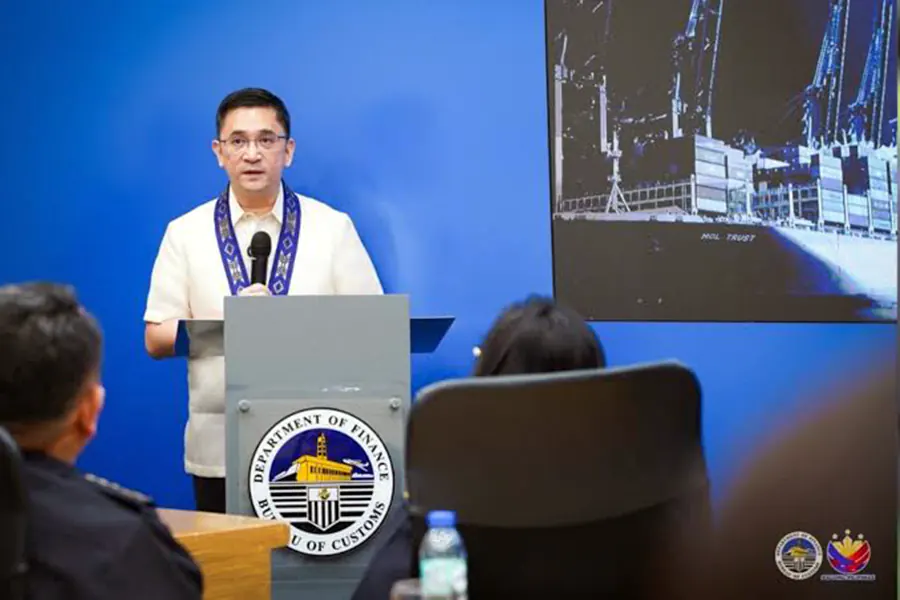
MOMENTS after being sworn in as the new Bureau of Customs (BOC) Commissioner, Charlito Martin Mendoza vowed to initiate more robust reforms designed to strengthen border security, improve revenue collection, combat smuggling, and facilitate legitimate trade.
Mendoza returns to the BOC with extensive experience in revenue administration, institutional reform, and public service, having previously served as Commissioner of the Bureau of Internal Revenue (BIR), Undersecretary of Finance, and District Collector of the BOC Port of Cebu, the Inquirer noted.
Mendoza previously served as district collector of the BOC Port of Cebu from July 2019 to October 2022, where he pursued improvements in revenue performance, border protection, operational efficiency, and quality management systems.
From April 2024 to November 2025, he served as Department of Finance undersecretary for the Revenue Operations Group, overseeing the revenue operations and collection performance of both the BIR and BOC.
A lawyer and licensed geodetic engineer, Mendoza ranked third in the 2004 Philippine Bar Examinations. He earned his law degree from San Beda University and his geodetic engineering degree from the University of the Philippines.
In his new role, Mendoza thanked the men and women of the BIR for their dedication and support, particularly in advancing long-term institutional and digital reforms.
“It has been a great honor to serve our country alongside our revenuers. I am proud of what we have accomplished together, especially the significant progress we have made in advancing the BIR’s long-term digital transformation. I know you will continue what we have started,” Mendoza said.
He also acknowledged outgoing Customs Commissioner Ariel Nepomuceno for the reforms undertaken during his leadership and expressed his commitment to building on those accomplishments.
“I look forward to working with the men and women of the BOC to carry out the priorities of President Marcos and Secretary Go—strengthening border protection, sustaining revenue collection, and facilitating legitimate trade,” Mendoza said.
Before his return to BOC, Mendoza led a comprehensive reform agenda at the BIR focused on improving taxpayer services, strengthening accountability, modernizing operations, and promoting voluntary compliance.
Central to these efforts was BIR DARES, a five-pillar reform program covering digital transformation, audit reform, revenue protection, employee empowerment, and service excellence. The program was institutionalized under the BIR Strategic Plan for 2026–2028 to ensure continuity beyond his tenure.
Among his major initiatives was the overhaul of the tax audit system, introducing a single-instance audit policy, subject to prescribed exceptions, risk-based taxpayer selection, anonymized audit assignments, and stronger safeguards against abuse.
These reforms were reinforced by the issuance of the 2026 Audit Manual and Consolidated Audit Program, developed following consultations with business organizations and stakeholders.
From January to October 2026, the BIR collected a record ₱2.809 trillion in gross revenue collections, up by 5.48 percent for the comparative period in 2025.
The Bureau also released ₱24.1 billion in tax refunds, up from ₱13.67 billion during the comparable period in 2025, providing additional liquidity support to businesses.
Mendoza championed a taxpayer-centered approach anchored on the principle “Assistance first to comply. Enforcement only when necessary.”
Through the nationwide CHAT initiative — or Counsel, Help, Assist Taxpayers — the BIR expanded taxpayer education and assistance while maintaining enforcement against deliberate tax evasion.
The BIR pursued criminal complaints involving major taxpayers and contractors, including cases connected to anomalous flood-control projects, and intensified enforcement against illicit tobacco and vape products, fuel-related tax violations, and other serious offenses.
His administration also advanced digital reforms, including the Electronic Invoicing and Sales Reporting System, the phased rollout of the Taxpayer Portal, Digital TIN ID services through eGovPH, and electronic processing initiatives designed to simplify transactions.
Other measures included tax relief for qualified micro taxpayers, improvements in business closure procedures, dedicated taxpayer service lanes for registered business enterprises, and clarification of VAT treatment for certain electricity charges and medicines.
Internally, Mendoza prioritized personnel development, career advancement, and integrity through accelerated promotions and the introduction of the Ethical Standards and Anti-Corruption Course.