

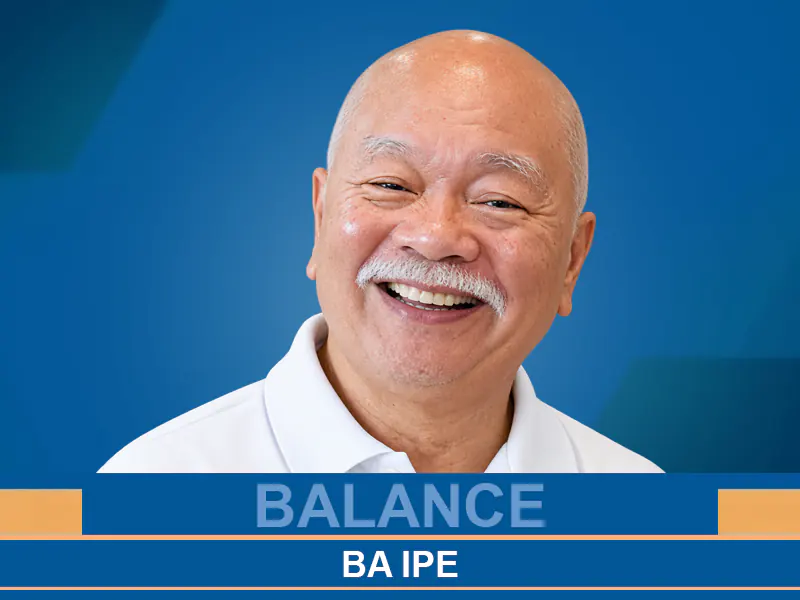
SOME people have asked about the psychological make-up of President Ferdinand Marcos Jr., who, in their opinion, appears to be distant, detached and, to a large extent, devoid of emotions in his manner and style of governing the nation.
There is a basis for these observations, as his psychological make-up has to be understood within the context of the cultural and political milieu that he grew up with. His formative years were in the latter half of the 1960s and it extended into the 1970s. He could be aptly described as a product of the turbulent decades of the 1960s and 1970s.
Ferdinand “Bongbong” Marcos Jr, or BBM, was eight, when his father and namesake took his oath of office as president on Dec. 30, 1965. Born on Sept. 13, 1957, or two days after his father celebrated his 40th birthday, the young Marcos saw two different generations that each carried their own persuasive capacity and capability.
The youth of the 1960s was described as largely optimistic and expansionist. Born roughly in the 1940s and mid-1950s, they saw the world winking with its postwar prosperity and the tolerable early Vietnam War. Although his father could have insulated him from all the turbulence and turmoil of that era, there was no way that BBM did not see the feel and the rising tide of Filipino nationalism as shown by the intense opposition to the presence of U.S. military bases in the country and the emergence of student activism here.
The father’s protective nature could have pushed him to send his son to study elsewhere, which happened, as he got reelected in 1969 and the country entered the 1970s with much trepidation and uncertainty. But this could prove to be his own undoing because the father became detached to the son. The lack of propinquity did not give them time to interact.
The 1970s were a different era. The youth in that decade was described as disillusioned, inward, and fragmented. They were disturbed by developments like the escalation of the Vietnam War and the U.S. eventual defeat, the rise of many protest demonstrations, assassinations, and shocking oil crisis. In this era, two kinds of youth emerged: the political activists and the “flower people” or hippies.
They differed immensely. The activists believed that political power should be confronted and redistributed. They conducted marches, strikes, organizational works with other sectors like workers, and their proselytization. They wanted to change the world. “Makibaka, huwag matakot! (struggle, don’t get afraid) was their battle cry.
The flower people were different. They retreated from the changing and turbulent world believing that consciousness should first change and political changes would follow. They built communes, lived communally, and used drugs mainly to escape from the realities. They experimented with free love and lived cheap as a choice. “Make peace, not war!” was their oft repeated refrain and motto.
Within this dichotomy, BBM appeared to have chosen the latter. It has been documented that he had lived like a privileged flower guy in some parts unknown, particularly in England, where he took his education. Even his father was quoted as complaining about his reported wayward lifestyle when he lived independently abroad.
There were also claims that he took drugs in his younger days as his way to escape the daily pressures of being the dictator’s son. This could explain his escapist nature. This could explain the President’s non-confrontational style of governance. He does not enjoy confronting people for their mistakes. He appears quick to forgive and would not run after these erring people
But it should not be mistaken for the President’s character. BBM is still a Marcos, who has inherited his father’s cunning and clever ways. Despite his non-confrontational ways, BBM, in many instances, knows how to play his political cards. He plays them adroitly.
The President did what other presidents failed to do during their incumbency. Without much public fanfare, BBM has sent a former president to jail without the latter knowing fully what occurred to him. BBM has likewise sent a senator and a former senator for allegedly plundering the national coffers and another senator for his stupid way of incriminating himself in a crime.
BBM has quietly initiated the two impeachment complaints against the Vice President. The second one has a big chance of success as Vice President Sara Duterte-Carpio faces the prospect of being moved from her office and perpetual disqualification to run for any public office. BBM did not have qualms to part ways with the powerful Duterte family, as he is set to free the country of the Duterte’s destructive political claws.
The curious thing is that BBM does not appear to have masterminded those initiatives. He does not enjoy being perceived as behind those moves. But who would believe him?
BBM is basically non-confrontational in his politics and governance, as he was essentially a product of the turbulent 1960s and 1970s. But he knows how to play his politics.