

SHEN Dingli, a professor for international relations at Fudan University, floated at an idea designed to end the maritime dispute at the South China Sea.
His proposal — allow Chinese fishermen within the 200-nautical mile Philippine exclusive economic zone (EEZ) in exchange for a fee.
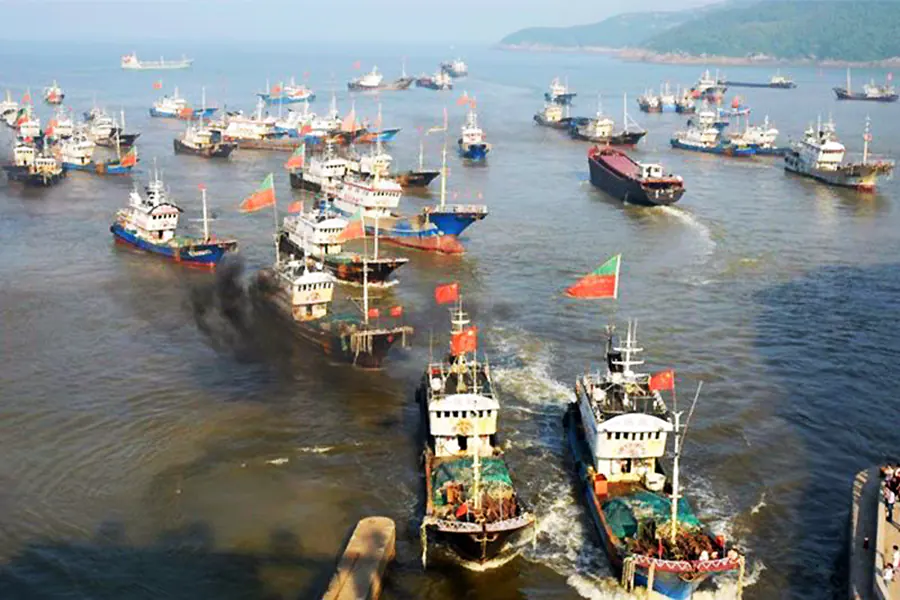
For over two decades, Chinese fishermen have been encroaching within Philippine waters.
China has also intensified its occupation in the disputed waters using force to drive away small Filipino fishermen and even Philippine Coast Guard and research vessels of the Departments of Agriculture and Science and Technology.
China went as far as building artificial islands where military installations were constructed. China’s military personnel, naval and air assets have already been deployed in these artificial islands well within the Philippine EEZ.
Moreover, Philippine authorities have confirmed the presence of Chinese research vessels inside the West Philippine Sea, an established rich resource for maritime and deepsea mines and natural gas.
Worse, Chinese fishermen are using trawlers and other heavy equipment that scrape the seabed and destroy coral reefs– the natural habitat and food source of marine species.
Dingli, a member of the academic committee at the Beijing-based Grandview Institution, said his proposal was intended as a middle ground to serve China’s large population and food needs, while earning for Manila revenues from permit fees.
“I may offend my government by proposing the following idea without consulting with my government,” he said at the Manila Dialogue on the South China Sea.
“[But] could we negotiate? You give some concession for our fishing people to come in with your permit, with a permitted slot to fish, and we pay a fee.”
“This is my humble idea.”
Shen’s recommendation comes as the Philippines and China remain locked in a dispute over the West Philippine Sea, which the UN Convention for the Law of the Sea flatly declared as well within the Philippines’ EEZ.
Maritime law expert Jay Batongbacal said strict limits would be needed on fishing methods and ecological impact, citing Chinese harvesting practices that the Philippines said would destroy marine habitats.
“The issue here is that the Philippines and China have been talking about fishing since the 1990s. And actually, when you look at the record of the arbitration in the 1990s on account of Mischief Reef, one of the key issues that was raised by the Philippines during that time precisely was fishing by Chinese fishermen on Philippine reefs,” he said.
“If we’re talking about sharing the fish, we also have to be clear about what fishing sector and what fish we are sharing,” Inquirer quoted Batongbacal.
Shen has taught China’s foreign policies at Colorado College since 2002. His research areas cover China-U.S. security relationship, nuclear arms control and disarmament, nuclear weapons policy of the United States and China, regional nonproliferation issues concerning South Asia, Northeast Asia and Middle East, test ban, missile defense, export control, as well as China’s foreign and defense policies.
He has co-edited “China’s Development Report”, “China and South Asian Relations in the 1990s”, “Conservatism and American Foreign Policy”, “Realism and U.S. Foreign Policy” and published over 500 articles and papers, 1/2 of which abroad in a dozen foreign languages. In addition, he has published over 20 papers in physics in China and abroad.
Dr. Shen has organized The Shanghai Dialogue (or Shanghai Initiative), a high level track-II series of meetings since 1994 involving China, India, Pakistan and the United States, has been viewed as one of the most important multilateral unofficial talks on nuclear arms control and nonproliferation involving these countries.
He is a member of IISS and a number of other international organizations and is on the editorial board of Contemporary Asia-Pacific Studies (China), South Asia Studies (China), Fudan Journal Social Sciences Edition (China), Journal of Contemporary China (U.S.), Journal of East Asian Studies (ROK/Japan/Taiwan), IRI Journal (ROK), INESAP Information Bulletin (Germany), and Nonproliferation Literature Review (U.S.), as well as on the international advisory board of Regional Studies (Pakistan).