

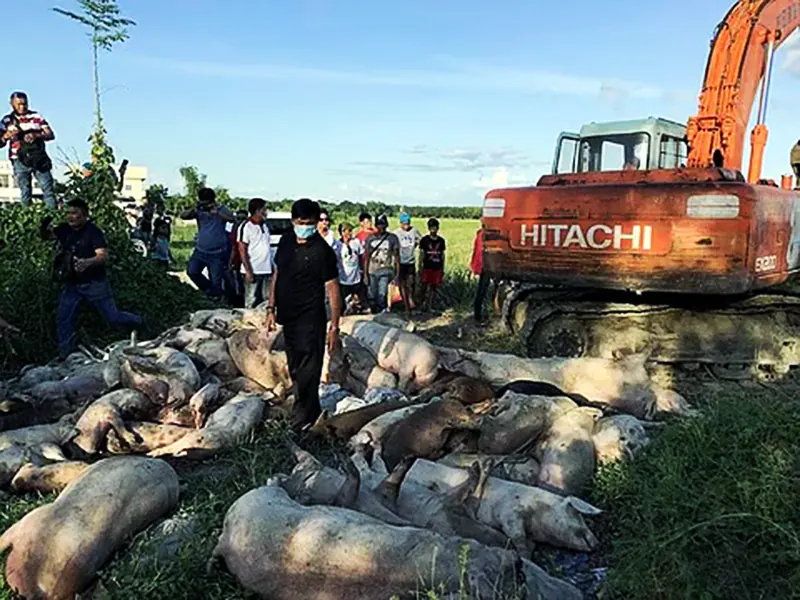
IF only the Department of Agriculture (DA) did its job, the local hog raising industry could have been spared from an inevitable loss amounting to a staggering P100 billion.
To make the matter worse, the DA allowed the dumping of cheap imported live pigs and pork cuts in the country, to the detriment of the local swine raisers.
According to the DA, the government is bound to ensure enough supply amid an onslaught of the so-called African Swine Fever to the local hog livestocks.
Based on government data, pork importation surged to 65 percent (from 39 percent) in the first half of 2026 for which the agriculture agency imposed a 60-day suspension on importation of live pigs and pork cuts and offals (including liver).
Sadly though, the local market has already been flooded with imported pork competing with local produce – causing the industry to lose about P100 billion until the end of 2026.
By issuing Department Order 33 imposing the 60-day ban on imports of live swine and pork cuts, the DA hopes to give local raisers a fair chance in the market this Christmas season.
Interestingly, Department Order No. 33 may only take effect after the Bureau of Customs itself would issue its own order to its port inspectors on the ban — a tedious process that would take another 15 days upon publication in a newspaper of general circulation.
The DA has suspended the importation of various pork cuts for two months and potentially longer as it moves to cushion the domestic hog industry from mounting losses that may reach ₱100 billion by the end of the year.
Agriculture Secretary Francisco Tiu Laurel Jr. said on Monday, Nov. 9, that he had signed DO No. 33 to implement a 60-day quantitative restriction (QR) on imported pork products as a provisional safeguard measure.
A QR refers to a trade mechanism that enables the government to limit the volume of a commodity that can be imported within a specific period.
Based on DO 33, the restriction covers the entry of various fresh and frozen pork cuts, including carcasses, ham, and shoulders, as well as edible offal such as liver.
It will take effect upon the issuance of a corresponding order by the Bureau of Customs (BOC) or 15 days after publication in two newspapers of general circulation, whichever comes first.
Laurel said the DA is imposing the import ban after its internal preliminary investigation found that rising imports of the commodity have caused serious injury to the local hog industry.
“The preliminary findings show that the surge in pork imports is putting severe pressure on our local producers,” he added.
The DA found that the ratio of pork imports to domestic pork production increased from 39 percent in 2021 to 61 percent in 2025, before rising further to 65 percent in the first half of 2026.
In absolute terms, it noted that pork imports rose by nearly 42 percent to 836,239 metric tons (MT) last year from 589,674 MT in 2023, the Manila Bulletin reported.
Domestic self-sufficiency was reported to have dropped from 74.3 percent in 2021 to 65.5 percent in 2025 and to just 54 percent from January to August this year.
Further, the DA said the country’s frozen pork inventory peaked at about 121,000 MT in July this year, with imported supplies accounting for around 94 percent.
It explained that this stock buildup caused farmgate prices to collapse by 50 percent year-on-year to ₱120 per kilo in the first half of the year from ₱240 per kilo.
The DA estimated that this resulted in losses of around ₱27.9 billion, which may double to ₱55.8 billion by year-end if weak prices persist. This is lower than industry estimates of as much as ₱100 billion.
Given concerns among industry groups that the 60-day import ban may be too short, Laurel said the government is open to extending the measure, although he did not say by how long.
“We can extend the period, just as we did with the rice import ban last year. But this requires a delicate balancing act because we also have to consider the needs of consumers and meat processors,” Laurel said.
Farmers’ group Samahang Industriya ng Agrikultura (SINAG) said the import ban provides temporary relief to the industry but stressed that restoring the previous tariff levels on pork imports remains crucial.
“The long-term solution remains the immediate restoration of pork import tariffs to their original levels of 40-percent out-quota and 30-percent in-quota,” SINAG said.