

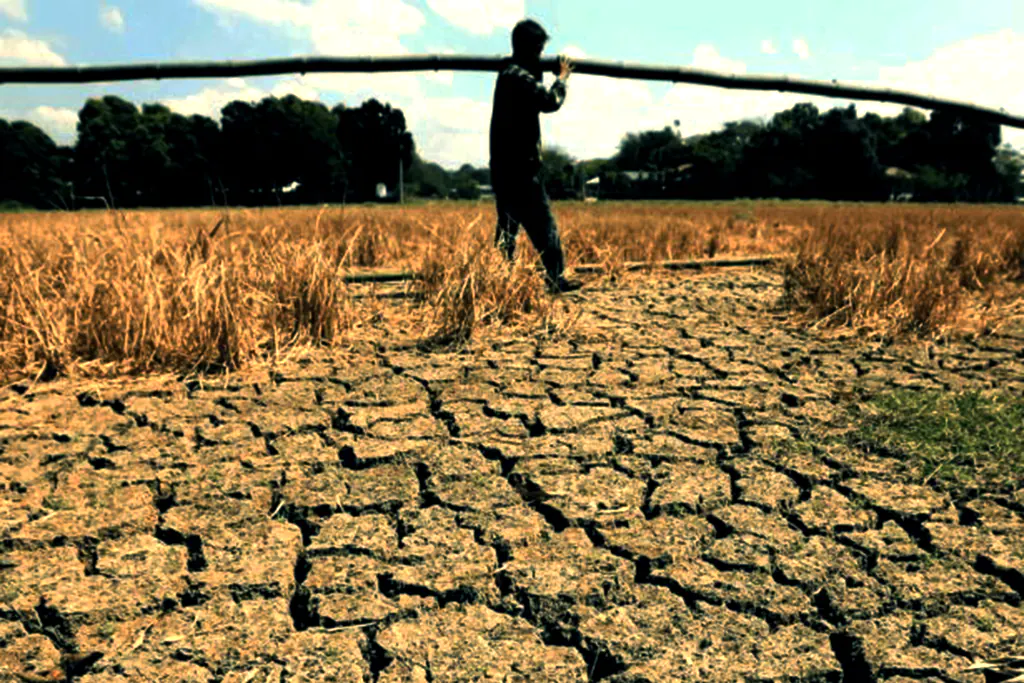
SCIENCE-based findings on the so-called Super El Niño requires an honest-to-goodness and doable contingency plan if only to cushion its impact.
Neither rhetorics nor a bucketful of antics would work. President Ferdinand Marcos Jr’s call for the public to buy buckets (balde) in preparation for the Super El Niño made him a laughing stock.
According to the President, the Filipinos should consider catching rainwater which could be filtered for domestic use. There’s just one glitch — scientists have predicted very little rain, which makes it rather more difficult.
At the Senate, a legislator called for intensified government preparations for worsening El Niño conditions, urging concerned agencies and local government units to translate early warnings into concrete measures to protect water supply, food production, livelihoods, and public health.
Monitoring System
This comes as Senator Bong Go commended the Department of Environment and Natural Resources (DENR) for its prompt deployment of monitoring and early-warning systems in several regions to track the possible effects of a strong El Niño and identify communities and ecosystems at risk before conditions deteriorate further.
“Mahalaga ang early warning, pero dapat may kasunod agad itong early action. Kung alam na natin kung aling mga lugar ang posibleng tamaan ng tagtuyot, matinding init at kakulangan sa tubig, ngayon pa lang dapat nakahanda na ang intervention ng gobyerno,” Go said.
The DENR said automated weather stations, satellite-based heat-stress monitoring, and Geographic Information System-based risk modeling are being used to monitor conditions in vulnerable areas.
Among the measures are a Red Flag Alert system for possible wildland fires in the Ilocos Region, sea-surface temperature and coral-bleaching monitoring in Central Luzon, and automated monitoring of heat indices, rainfall deficits, and water levels in the Agusan Marsh. Similar systems are being used in parts of Bicol to detect drying creeks, forests, and shallow reefs.
Reduced Rainfall
The Philippine Atmospheric, Geophysical and Astronomical Services Administration (Pagasa) has warned that the developing El Niño could persist until March or even June 2027.
Around 40 provinces are expected to experience reduced rainfall, with the number potentially doubling by January. Air temperatures could reach 38.7 degrees Celsius by March, while heat indices may climb between 45 and 52 degrees Celsius.
Go urged the Department of Agriculture, National Irrigation Administration, water districts, local governments, and other concerned agencies to prepare contingency plans for areas vulnerable to water shortages and drought.
“Tubig ang isa sa pinakamahalagang pangangailangan kapag may matinding tagtuyot. Kailangan natin protektahan ang supply para sa mga tahanan, ospital, paaralan at sakahan. Ayusin natin ang distribution, irrigation at conservation measures habang may panahon pang maghanda,” he said.
Food Security
The senator likewise stressed the need to protect farmers and fisherfolk whose incomes can quickly disappear when crops fail, irrigation water becomes scarce, or fishing conditions deteriorate.
Government data cited by Go earlier this month showed that 106 cities and municipalities across five regions had already declared states of calamity because of intensifying dry conditions. More than 388,000 individuals had been affected, while agricultural damage and production losses reached an estimated ₱5.56 billion, affecting over 201,000 farmers and fisherfolk.
Go urged agriculture agencies to continue providing seeds, fertilizer, fuel assistance, irrigation support and other interventions while ensuring that affected farmers receive assistance without unnecessary delays.
“Kapag nasira ang pananim, buong pamilya ang nawawalan ng pagkakakitaan. Apektado rin ang ating food supply. Kaya kailangang protektahan natin ang mga magsasaka at mangingisda at bigyan sila ng paraan para makabangon at makapagsimula ulit.”
Public Safety
Go earlier filed Senate Bill No. 673, which seeks to provide full crop insurance coverage for qualified agrarian reform beneficiaries, particularly smallholder farmers cultivating five hectares or less. The proposal is intended to provide farmers with greater financial protection against losses caused by natural calamities and other risks to agricultural production.
The senator also urged the Department of Health and local health authorities to intensify preparations not only for heat-related illnesses such as dehydration, heat exhaustion and heat stroke, but also for infectious and water-borne diseases that may become more difficult to control as temperature, rainfall patterns, humidity, and water availability change.
Past El Niño episodes have shown the potential scale of the public health threat. During the severe 1998 El Niño, the Philippines recorded around 40,000 dengue cases, about 1,200 cholera cases, and nearly 1,000 typhoid cases nationwide.
Heightened Risk
Go said prolonged heat and changing environmental conditions can heighten health risks in several ways, including increased exposure to mosquito and rodent-borne illnesses such as dengue, malaria and leptospirosis.
The senator also allayed fears over water-borne diseases such as cholera and schistosomiasis; food-borne and diarrheal illnesses, including typhoid; respiratory conditions such as asthma, bronchitis and respiratory infections; and heat-related conditions ranging from sunburn and heat stress to severe dehydration and heat stroke.
Health authorities have also noted that organisms responsible for transmitting infectious diseases are highly sensitive to changes in temperature, rainfall and humidity. Mosquito-borne diseases such as dengue and malaria are particularly affected by these environmental conditions.
Vulnerable Sectors
Other concerns require adequate stocks of medicines and medical supplies, strengthened disease surveillance, access to safe drinking water, and clear community-level information on preventing both heat-related and infectious disease emergencies, particularly among children, senior citizens, outdoor workers, farmers, and people with existing medical conditions.
“Kapag sobrang init, mabilis magkaroon ng dehydration at heat exhaustion. Dapat alam ng mga tao kung paano umiwas, saan kukuha ng malinis na tubig, at saan agad lalapit kapag may nararamdaman,” Go averred.
He also reiterated his call for employers and concerned government agencies to protect workers regularly exposed to extreme heat, including construction workers, delivery riders, farmers, street personnel, and other outdoor workers. He previously pushed for sufficient rest periods, accessible drinking water, and appropriate workplace safety measures during periods of dangerous heat.
“Dapat inuunahan natin ang problema. Habang may datos at warning na tayo, gamitin natin ito para makapaghanda. Siguraduhin nating may tubig, pagkain, serbisyong pangkalusugan at suporta sa kabuhayan bago pa lumala ang epekto ng El Niño,” Go said.
“Buhay, kalusugan at kabuhayan ng ating mga kababayan ang dapat nating protektahan. Kung maaga tayong kikilos at maayos ang koordinasyon ng lahat ng ahensya, mas marami tayong maililigtas at matutulungan,” he concluded.