

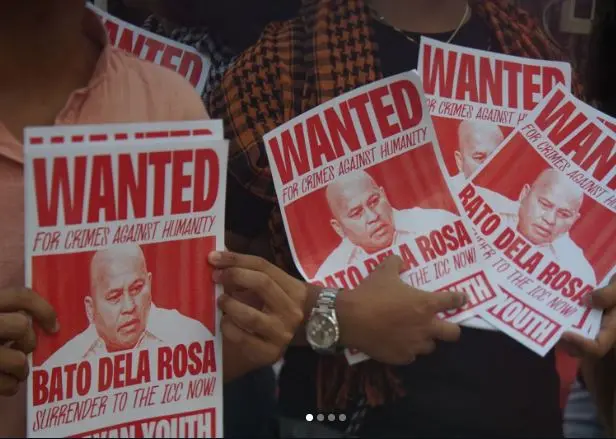
DOUBTS are raised over the government’s decision to put up a P50-million reward for the arrest of Senator Ronald “Bato” Dela Rosa, whom Interior Secretary Jonvic Remulla claims to know where the fugitive is supposedly hiding.
No less than pro-administration Senator Panfilo Lacson finds no logic to raise a huge bounty for a fugitive with “known location.”
At the House of Representatives, Mamamayang Liberal partylist Rep. Leila De Lima echoed Lacson’s sentiments.
According to De Lima, there’s no need for the government to raise a staggering amount for “any information leading to the arrest of Dela Rosa whom she said is still entitled to due process, a fundamental right guaranteed to every Filipino.
Remulla announced the reward on October 23, as authorities sought to locate the opposition legislator facing an arrest warrant from the International Criminal Court (ICC) over alleged crimes against humanity linked to former President Rodrigo Duterte’s unforgiving anti-drugs campaign.
The senator has been out of the public eye and has since been declared a fugitive by the foreign tribunal.
Inquirer columnist Segundo Eclar Romero said there is no question that Dela Rosa should be apprehended. But is a P50-million bounty effective, lawful, and an accountable way to achieve that objective?
“A reward can be a legitimate instrument of law enforcement. People sometimes possess information that police investigators lack. Rewards can compensate for the risks and inconvenience of cooperation and encourage people outside official investigative networks to share useful information,” he pointed out
For the current year, the Philippine National Police (PNP) distributed P9.2 million to 21 confidential tipsters whose information contributed to the arrest of 21 wanted persons. The practice demonstrates that rewards can support apprehensions.
“But not every reward is equally effective, nor will a much larger payment produce proportionately better results,” Romero noted.
Fifty million pesos is an eyebrow-raising amount to offer for information leading to the arrest of one man. For many Filipino families, it represents years of earnings, money that could pay for education, medical treatment, or the repair of a flood-damaged home.
In Dela Rosa’s case, the ICC unsealed his arrest warrant on May 11, 2026, alleging responsibility for murder as a crime against humanity. He had denied such allegations and his legal counsel has questioned the legal foundation for the bounty, arguing that no Philippine court had issued a domestic arrest warrant and raising concerns about the use of government intelligence funds.
Apart from the legal issues, he asked a practical question:
“What does the bounty actually buy? Informants may fear retaliation. Associates may remain loyal or distrust authorities. The fugitive may change locations, use intermediaries, or benefit from institutional weaknesses. If credible information leads authorities to the fugitive and enables a safe, lawful arrest, the reward may be money well spent. The more extraordinary the amount, the greater the obligation to demonstrate that the expenditure is justified,” Romero pointed out.
But if the announcement produces no actionable intelligence, it may amount to little more than an expensive declaration of intent.
The broader issue is public confidence. If the government can mobilize extraordinary resources to pursue one prominent official, citizens may reasonably ask whether comparable determination is applied to other wanted persons, including those implicated in corruption or violent crime.
Enforcement priorities may legitimately differ, but the criteria should be intelligible and consistently applied, the columnist stressed.
Offering tantalizing bounties might be an invitation to vigilantism. Citizens should be encouraged to provide information through secure channels, not to undertake private arrests, threaten suspects, or circulate unverified allegations.
An important design principle should be: separate information, investigation, and arrest to protect the public from becoming an informal arrest force.
Rewards should never be interpreted as authorization for vigilante action, coercion, trespass, or violence. The responsibility for verifying intelligence and executing warrants belongs to authorized officers acting within the law.
Bounties should be an instrument of last resort, Romero emphasized citing various relevant enforcement mechanisms that must be continuously improved: the Department of Justice Witness Protection, Security and Benefit Program under Republic Act No. 6981; the Ombudsman and agency reporting mechanisms; 8888 Citizens’ Complaint Center and Department of the Interior and Local Government Bantay Korapsyon; and community-oriented policing, with safeguards against local political interference.
Wielding the bounty mechanism reflects the inadequacy of a broader system of citizen-assisted enforcement that draws on different motivations and capacities, such as allowing citizens to report sightings or information without publicly identifying themselves; making cooperation safer for people facing threats; enabling insiders to disclose concealment, misconduct, or obstruction; and building ongoing relationships that can generate reliable information.
Bounties Under Marcos
Under the Marcos administration, high-profile monetary rewards and bounties have been strategically offered by law enforcement and government departments to secure the arrest of fugitives, particularly individuals implicated in human rights abuses, trafficking, or international warrants.
The President has consistently defended these measures as legitimate operational strategies to enforce the rule of law.
Among the “prized fugitives” under the Marcos administration include Dela Rosa (P50 million), Apollo Quiboloy (P14 million), Atong Ang (P10 million), Gerald Bantag (P2 million) to name a few.
Two other high profile fugitives were never considered to be worthy of a bounty on their head. They are former Ako Bicol partylist Rep. Zaldy Co, a main character in the so-called flood control scandal and former Negros Oriental Rep Arnolfo Teves (who has since been detained at the Metro Manila District Jail in Taguig City after being arrested in Timor Leste) for the murder of former Negros Oriental Gov. Roel Degamo.
Romero said bounties should be assessed at three levels:
- Operational effectiveness: Does it produce reliable information that helps locate and lawfully apprehend the fugitive?
- Institutional effectiveness: Does it strengthen cooperation between the public and law-enforcement institutions without encouraging abuse or replacing professional investigation?
- Political and social legitimacy: Does the public regard the reward as a credible, fair, and appropriate means of enforcing the law, including against powerful officials?
These are measurable questions that the government should be prepared to answer.
Prior to the Duterte administration, bounties for top-tier high-profile fugitives were issued by the Department of the Interior and Local Government (DILG) and the Department of National Defense (DND).
Some of the largest rewards included:
Zulkifli Abdhir alias Marwan, P50 million ($5 million from the US rewards program) for the tragic 2015 Mamasapano clash under the late President Benigno Aquino III. He was a high-profile Malaysian terrorist and bomb maker hiding in Mindanao.
In 2012, the Aquino III administration placed massive bounties on five high-profile fugitives namely:
- Maj. Gen. Jovito Palparan (dubbed “the Butcher” for enforced disappearances for P5M)
- Asiatique real estate developer Delfin Lee for the P6.6-B housing scam for P2 million)
- Former Palawan Gov. Joel Reyes and brother Mario, for the murder of Gerry Ortega for P2 million each
- Dinagat Island cult leader/politician Ruben Ecleo Jr. wanted for parricide and graft for P2 million;
- CPP-NPA leaders Benito and Wilma Tiamzon (in 2012) with bounties shelled in by DND-DILG for 5.6 million each
- Abu Sayyaf Group leaders (during Arroyo’s term) P5 to P10 million for the high profile kidnappings at Dos Palmas in 2001. The leaders identified were Khadaffy Janjalani and Abu Sabaya who carried multi million peso bounties funded by both the Philippine and US Rewards for Justice Program.
During the Duterte administration, he introduced standard cash rewards for lower-tier criminality, alongside massive state payouts for high-profile figures.
He ordered P1 million per head for heinous crime convicts; P2 to P3 million for the rogue Ninja Cops; P20,000 to P1 million for the drug war “Davao Template; ” up to P10 million for active communist insurgent commanders and local ISIS-affiliate leaders (such as the Maute brothers during the 2017 Marawi Siege).