

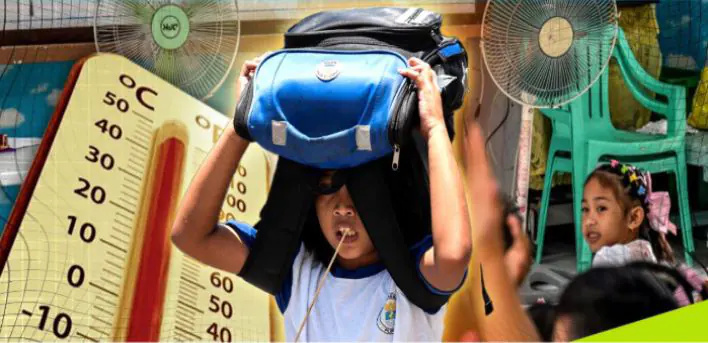
SCHOOL administrators may suspend classes once the local temperature hits 42 degrees Celsius, if only to ensure the safety of the academic community.
In a statement, the Department of Education (DepEd) cited the urgent need to prioritize safety and well-being of both the students and teachers amid hot temperatures in view of the so-called Super El Niño.
Education Secretary Sonny Angara however clarified that local government units must be informed by the school administrators as a matter of coordination, as provided under DepEd has issued Memorandum No. 64 series of 2026, which sets comprehensive guidelines for schools during the El Niño.
“School officials should just notify the LGU, part ‘yun, required iyon kasi part of coordination iyon para hindi magulat si mayor or so governor na bakit nag-uwian na ‘yung mga bata,” said Angara in a media interview at Lakan Dula High School in Tondo, Manila
The Department of Science and Technology (DOST) earlier warned the public to brace for record-breaking temperatures, induced by the extreme weather phenomenon.
Under the new memorandum, extreme heat will no longer trigger a blanket suspension nationwide. Instead, school heads are expected to use a localized, decision-making tool that relies on indoor classroom temperature and humidity readings taken at 8 a.m., 12 noon, and 2 p.m.
According to the DepEd’s new guidelines, there will be regular, face-to-face classes if the heat index is below 27 degrees Celsius.
When conditions rise to anywhere between degrees Celsius to 32 degrees Celsius, school heads can choose to shorten onsite hours or transition into hybrid learning.
Once the heat levels reach anywhere between 33 and 41 degrees Celsius, physical classes are suspended and learners will shift to home-based tasks.
If the heat level reaches 42 degrees Celsius and above, physical and home-based activities are completely suspended.