

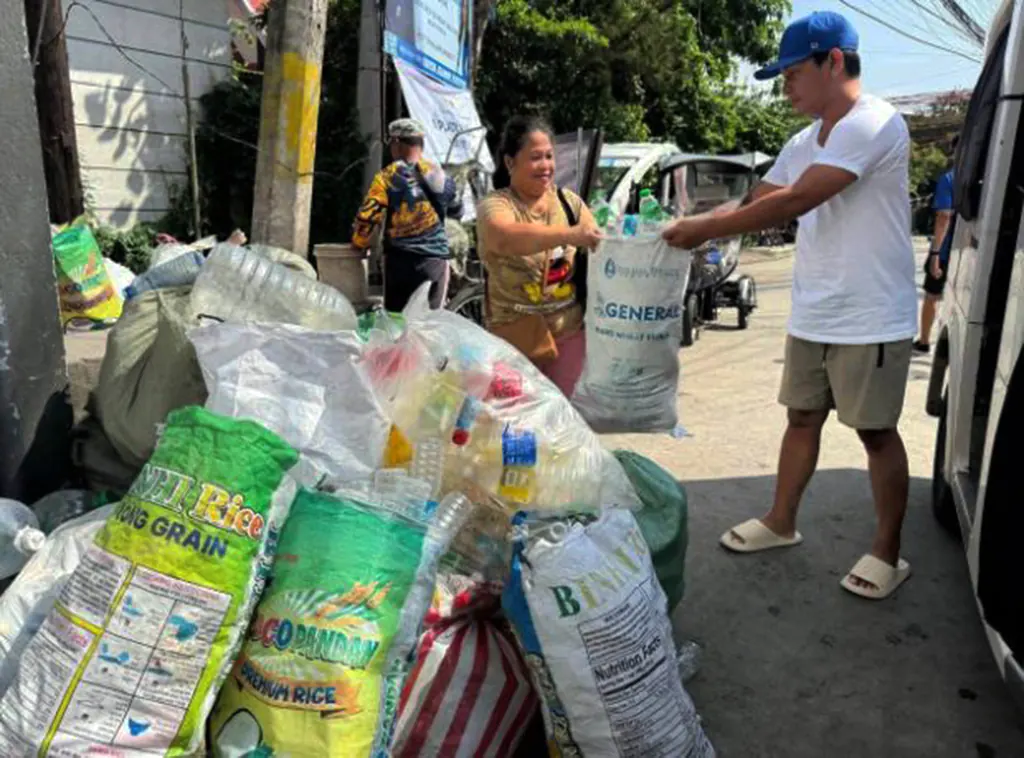
TO GIVE a hard push at recycling, a bill had just been filed by a district congressman embarking on a livelihood system designed to reward households and organizations with food or cash for turning over recyclable wastes.
Under House Bill 11146 (Basura to Ayuda Act), its proponent, Quezon City 5th District Rep. Patrick Michael Vargas seeks to incentivize a solid waste redemption and recovery system to allow households, homeowners’ associations, civic organizations and individuals to exchange non-hazardous recyclable materials for food, groceries or cash.
Under the proposed measure, a kilogram of recyclable plastic could be exchanged for one kilogram of commercial-quality rice or its cash equivalent. A kilogram of metal waste could be exchanged for two kilograms of rice or its cash equivalent.
“Through this bill, we hit two birds with one stone. We take care of our environment while giving aid to our people (especially the poorest of the poor),” Vargas said in a statement.
Vargas said the proposal was modeled after the Quezon City government’s Trash to Cashback program, which rewards residents for participating in waste management initiatives.
The Philippines generates an estimated 61,000 metric tons of solid waste daily, according to the Department of Environment and Natural Resources.
Plastics account for an estimated 12% to 24% of the country’s solid waste, based on DENR data.
Under the bill, the DENR, the Department of Agriculture and the Department of Trade and Industry would be charged with setting standardized trade-in centers and ensuring consistent exchange rates across communities.
“Turning waste management into a national habit is essential to safeguarding the environment and securing a healthier future for the country,” Vargas said.
Records show that the country faces a severe garbage and plastic waste crisis, generating over 60,000 metric tons of solid waste daily—driven heavily by a “sachet economy” of single-use plastics.
This mismanaged waste clogs urban waterways, intensifies monsoonal floods in Metro Manila, and makes the country a leading contributor to global marine plastic pollution.
Consumer goods manufacturers depend heavily on cheap, single-use multilayer plastic sachets and pouches for everyday consumer goods.
Hundreds of local rivers—led principally by the Pasig River—carry vast amounts of plastic waste directly into the ocean.
A shortage of functional material recovery facilities (MRFs)– mandated by Republic Act 9003 of December 20, 2000 also known as the Ecological Solid Waste Management Act of 2000– required every barangay or cluster of barangays to establish an MRF to handle waste sorting, recycling, and composting.
Local government units (LGUs) are directed to implement systematic waste reduction programs to divert solid waste away from disposal sites.
The Department of Environment and Natural Resources, through the Environmental Management Bureau, was tasked to oversee compliance alongside local boards.
Another setback to the ecological waste management law was the limited sanitary landfills, and incomplete collection coverage in provincial areas.
Lacking reliable trash pickup, many communities resort to open-air burning of plastics, creating severe health hazards.
Like most other laws of the country– churned by the House and the Senate– enforcement remained lacking, if at all, until such laws gathered dust in shelves.