

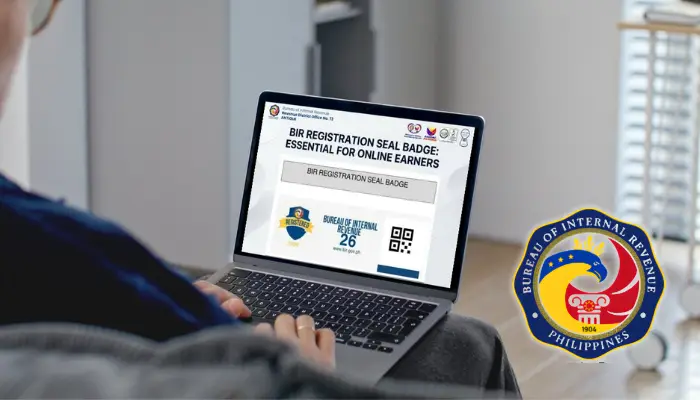
THE Bureau of Internal Revenue (BIR) has issued guidelines governing its registration seal badge for online businesses– big or small– which comes with answers to commonly-asked questions, most of which came from start-ups and still unviable online merchants and content creators.
The badge covers online sellers, freelancers (that include translators, tutors and consultancy services), professionals, content creators and many more sprouting business entrepreneurs using the internet platforms.
Many Filipinos – employed or not – are turning to online businesses either to augment their incomes or for home or mobile-based self-employment to improve their family incomes.
Many in fact have turned to the internet because of difficult daily commute, parenting concerns and other contingencies that hinder their mobility. The products they sell can range from food, clothing and others as well as personalized services in accounting, taxation, education and the likes.
The common concerns being raised about the BIR Registration Seal Badge include, would the registration mean immediate imposition of taxes, what if the small business is just new and has not yet earned, would there be exemptions for small merchants and professionals and why the need to register if the circumstances do not yet merit payment of taxes because of inadequate or erratic revenues from the business.
Below are the English translation of the guidelines and common Q &As that the BIR released:
- What is the BIR Registration Seal Badge?
It is an official digital badge featuring a QR code. It is used to verify the BIR registration of a business or a professional. This is displayed online in place of the full Certificate of Registration (COR).
- What is its benefit as a taxpayer?
It is easier for you to show customers that you are registered with the BIR, without needing to publish your entire COR to provide proof. It also helps meet the requirement to display registration online.
- Is the badge a guarantee that all transactions are trustworthy?
No. It is proof of registration, not a guarantee of product quality, service, or delivery. It is neither a tax clearance nor proof that all taxes have been paid. Consumer vigilance remains important.
- Is the badge a new tax?
No. Registration, displaying the badge, filing tax returns, and paying taxes are different things. Existing registration and online display requirements were already in place before the badge was introduced. Tax due is based on the law and your actual situation.
- Is the law requiring registration new?
No. The registration requirement has long existed under the National Internal Revenue Code of 1997, as amended, and various BIR issuances.
This was further clarified for online businesses through the following issuances:
- Section 236, NIRC, as amended — Legal basis for taxpayer registration.
- RMC No. 60-2020 — Registration and tax compliance of businesses using electronic platforms.
- RR No. 7-2024 — Registration, invoicing, and online display requirements.
- RR No. 15-2024 — Mandatory registration for individuals engaged in business, whether online or physical.
- RMC No. 38-2026 — Introduction of the Registration Seal Badge in place of online display of the full Certificate of Registration.
- Who is covered?
This includes online sellers and service providers on digital platforms or those with an online business presence. It also covers professionals, freelancers, and content creators who earn from ads, views, affiliate commissions, sponsorships, or similar activities. Not just sellers of physical products need to look into this requirement.
- Will everyone who gets a BIR Seal Badge be immediately subjected to income tax?
No. Obtaining a Seal Badge does not automatically result in an income-tax assessment or an amount due. Income tax is calculated based on existing laws and the applicable tax regime. A registered taxpayer may fall under the following:
- Have zero income tax to pay because their taxable income is in the zero-tax bracket.
- Have zero income tax to pay due to a legal exemption.
- Have income tax to pay because their taxable income exceeded the applicable threshold.
- Have other business-tax obligations even if income tax is zero.
The badge itself is not a tax assessment.
- Does everyone using Facebook, TikTok, Instagram, YouTube, or any social media account need to register?
Simply having a social media account is not a reason to register as a business.
For example, if the account is only used for personal communication, family photos, or ordinary personal activities, it is not covered by the business Seal Badge requirement for that reason alone.
However, if it is used to regularly sell, offer professional services, or earn from commercial digital activities, business registration may be required.
- What if I only occasionally sell my old personal items?
The occasional sale of personal items is different from regular selling for profit. Using an online platform is not enough to immediately declare it a business. If your situation is unclear, disclose the frequency and type of your transactions to your RDO (Revenue District Office).
- Do I still need to register if my sales are small?
Yes, if you are running a business that requires registration or practicing a registered profession. Low sales or zero income tax do not automatically exempt you from business registration. Treat registration requirements and tax computations separately.
- I already have a TIN as an employee. Is that enough?
Having a TIN is not equivalent to registering a sideline or business. Use your existing TIN and update the registration for your business or professional activity. Do not get a new TIN.
- My business is already registered. Do I have to start over?
You do not need to create a new business registration just because of the badge. Check if the name, address, line of business, and other details in your records are correct. If necessary, update them to obtain the COR and badge through the proper process.
- When must the badge be displayed?
The extension under RMC No. 99-2026 is until October 31, 2026. Within the extension period, there are no penalties solely for failing to display the badge. This does not invalidate other obligations regarding registration, filing, or payment. Check the latest BIR issuance before relying on any new extensions.
Important Note: The badge deadline is not permission to delay registering a business that should already be registered.
- Where can I get the badge?
Through the BIR Online Registration and Update System (ORUS), or at the Revenue District Office (RDO) where you are registered. If you are not yet registered as a business or professional, prioritize proper registration first.
- What is the simple sequence of steps to take?
- First, review your business registration and COR.
- Second, use ORUS or visit your RDO for necessary updates and to secure the badge.
- Third, obtain the official badge and test the QR code.
- Fourth, display it on the appropriate pages of your online business.
- Is there a fee for this?
The badge itself is free. There is a ₱30 loose Documentary Stamp Tax indicated in the ORUS update process to secure it. The document fee and the free badge are separate. The former ₱500 annual registration fee has been removed as of January 22, 2024.
- Where should I post it?
In an area easily seen and accessed by customers: for example, the About, Business Permits, or Government Compliance sections of a website; or the seller profile, shop details, and business page of a platform. If you use multiple online sales channels, ensure requirements are met on the appropriate pages.
- Should I upload the full COR?
Post the badge only. You may crop or retrieve the badge from the document issued by BIR. Keep the badge itself clear and unaltered, including the design and QR code. Do not cover any part of it.
- How do you know if the QR verification is correct?
Scan the QR code and ensure the destination is the official BIR verification link at [https://verify.bir.gov.ph/correspondence/](https://verify.bir.gov.ph/correspondence/) before relying on the result. Check that the registration details match your business. A picture of the badge alone is not sufficient verification.
- What if the QR code doesn’t work or the details are wrong?
Try using the clear original file and a different QR scanner. If problems persist, keep a screenshot or error message and contact your RDO. Do not create or edit your own QR code. Do not give your password or OTP to anyone offering assistance.
- What is the actual connection between the BIR Seal Badge and taxes?
It is related to compliance with tax rules, but it does not determine how much you will pay.
- What is the difference between sales, profit, and taxable income?
- Gross sales are total sales before deducting expenses, according to applicable tax rules.
- Profit is what remains after deducting expenses.
- Taxable income is the amount upon which income tax is based after allowable deductions and adjustments. Not all expenses are automatically deductible.
- Is it true that there is no income tax if earnings are up to ₱250,000?
Under graduated income-tax rates for individuals, annual taxable income not exceeding ₱250,000 is taxed at 0%. This is not a general exemption from registration or all taxes, nor is it automatically based on total sales.
- What is the 8% income-tax option?
This is an option for qualified self-employed individuals and professionals. Conditions include not being VAT-registered and gross sales/receipts plus other non-operating income not exceeding ₱3 million. This replaces graduated income tax and Section 116 percentage tax. It must be properly selected each taxable year; it is not automatic.
- Is there also a ₱250,000 deduction under the 8% option?
Yes, for a qualified individual who is fully self-employed. However, if you also have compensation income as an employee, there is no separate ₱250,000 reduction on business income under the 8% option. This applies even if your taxable compensation is lower than ₱250,000.
- What are percentage tax and VAT?
For a non-VAT business covered by Section 116 under the graduated income-tax regime, there is typically a 3% percentage tax on gross sales. VAT is typically 12% on applicable transactions, with its own exemptions and rules. The ₱3 million VAT threshold is not an exemption from business registration.
- I have no sales or suffered a loss. Do I still need to file?
Generally, yes, for returns applicable to your registration, unless there is a specific exemption. Under the 8% option, sales are the basis, not profit. If you have completely ceased business operations, process closure with the BIR; do not simply stop filing.
- I am purely self-employed with ₱200,000 in sales under the proper 8% option. How much is the tax?
₱0 income tax because qualifying annual sales and other non-operating income did not exceed ₱250,000. There is also no separate Section 116 percentage tax. Registration, recordkeeping, and income-tax filing requirements still apply.
- What if my sales are ₱400,000 under the same 8% option?
If purely self-employed with no other qualifying income: $(\text{₱400,000} – \text{₱250,000}) \times 8\% = \text{₱12,000}$ income tax due. There is no separate Section 116 percentage tax. Business expenses are no longer deducted in the 8% computation.
- I am an employee with ₱200,000 in sideline sales under the 8% option. Is it also zero?
No. The business income tax is $\text{₱200,000} \times 8\% = \text{₱16,000}$, assuming no other qualifying business income or adjustments. There is no ₱250,000 reduction on the business component for a mixed-income earner. Compensation tax is calculated separately using graduated rates.
- I am under graduated rates and my taxable income is only ₱180,000. Are there other taxes?
Possibly. If sales are ₱400,000 and allowable deductions are ₱220,000, taxable income is ₱180,000 and income tax is ₱0 if there is no other taxable income. If covered by Section 116 with no exemption, the 3% percentage tax on ₱400,000 sales is ₱12,000.
- Am I exempt if my online sales are below ₱500,000?
This is not a general tax exemption. The ₱500,000 threshold in rules for online sellers refers specifically to creditable withholding taxes on remittances from e-marketplaces and digital financial service providers, subject to conditions and sworn declarations. It does not remove registration and other tax obligations.
- Are BMBEs (Barangay Micro Business Enterprises), senior citizens, or PWDs automatically exempt?
Being a small business, senior citizen, or PWD is not enough to be exempt from all business taxes. A qualified BMBE may enjoy an income tax exemption within the scope of its operations, but registration and exemption requirements must be met. You cannot combine a BMBE income tax exemption with the 8% option.
- Is the badge enough to say my compliance is complete?
No. Maintain proper books of accounts, issue appropriate invoices, file required returns, and pay the correct taxes on time. Keep your COR, badge, filing confirmations, and payment records. Update your registration when changes occur.
- Is there an automatic audit or tax amnesty when getting a badge?
The badge requirement does not include automatic tax assessments or tax amnesty. Getting a badge does not erase past obligations. If you receive a notice or a request for payment, verify the basis and official payment method with your RDO.
- What should I prepare when inquiring at the RDO?
Prepare your TIN, COR (if available), type of job or business, online pages used, annual sales, expenses, other income, and current tax option. Ask if your registration is correct, how to secure the badge, and which returns and deadlines apply to you.
Key Reminder: Display your registration using the correct badge. Understand your tax computation and filing duties separately. The goal is to provide clear proof of registration and proper fulfillment of your obligations.
- Should registration be a cause of fear for taxpayers?
It shouldn’t be. It should be the start of a clearer understanding of your rights and obligations.
A small online seller should not think that just because they are registered, their taxes will instantly be heavy.
A freelancer should not assume that just because they got a Seal Badge, they automatically have a tax assessment.
And a content creator should not fear having to display their entire COR to prove they are registered.
There are thresholds, tax options, exemptions, and legal safeguards that must be understood and properly implemented.
Registration is not a punishment; tax exemption is a right provided by law, and the correct tax is only that which complies with the law.