

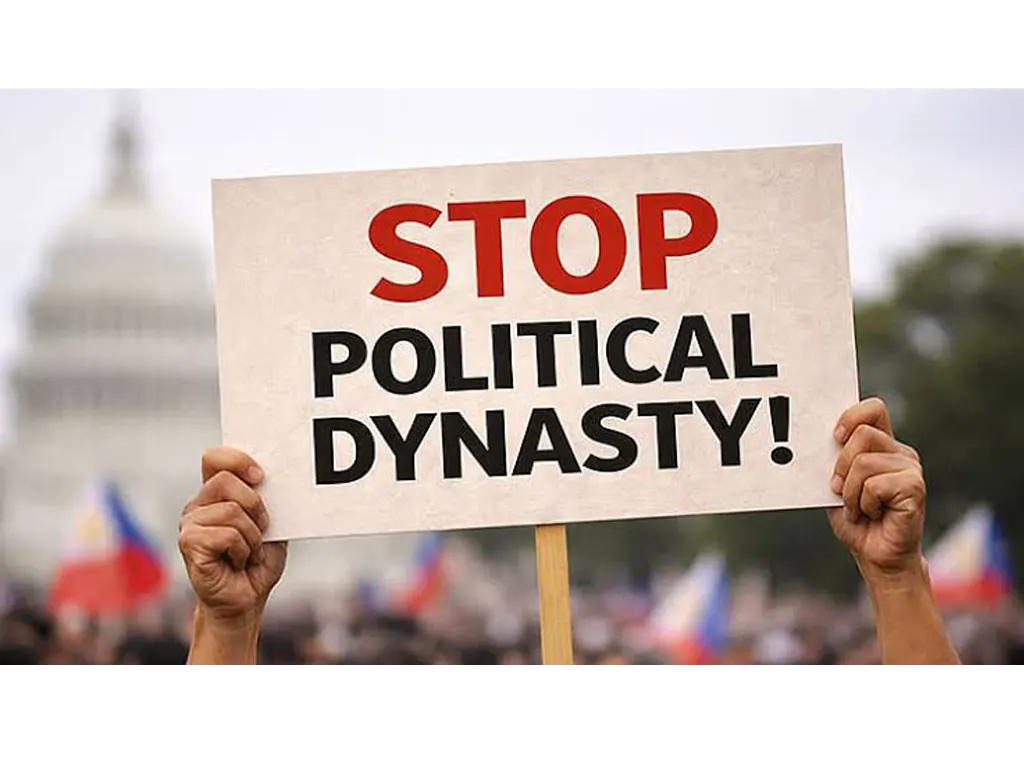
WHEN THE Supreme Court admonished past ang present Congress for failure to enact an enabling law for political dynasty ban, House Speaker Faustino Dy III claimed that it’s the Senate that has yet to act on it.
According to Dy, the House of Representatives had approved on third and final reading its proposed measure which bans political dynasties of up to second degree of relation.
The High Tribunal apparently is not pleased, and so with the general populace about the proposed measures, as they seek to perpetuate, and not dismantle political clans and dynasties that in decades past have deepened their hold on their communities to ensure their perpetuity.
A better version is with Senate bill 1901 (pending on second reading) that UP Political Science Prof. Jean Franco calls “more progressive” as it not only bars the simultaneous holding of positions but also immediate succession after a relative steps down from a certain post.
The Senate’s counterpart version defines “relatives” in public office within the second civil degree of consanguinity or affinity, whether legitimate or illegitimate, full or half-blood.
But HB 8389 essentially ‘legitimizes’ dynasties since it does not prevent family members from simultaneously occupying different positions in a province, Franco said.
Key provisions of the approved House bill allow spouses and relatives to run as representatives at the same time as long as they are in different districts and belong to different party lists; and to seek various posts in the barangay, municipal, and provincial levels as long as there is no sitting family member.
Yet, the SC on Monday pushed for up to fourth degree of relation, meaning up to first cousins, great uncles, great aunts, grand nieces and grand nephews and great, great grandparents by blood and first cousins in law and spouses of great aunts and great uncles by marriage.
The scope of the bills seeking a ban on dynasties in public office must be extended to up to the fourth civil degree of familial and spousal relations, said Associate Justice Ramon Pail Hernando, the ponente in SC’s August 26 decision released last week.
In the decision, the SC placed the blame squarely on Congress for the concentration of political power to only a few families, thereby “distorting democracy, weakening accountability and fostering conditions conducive to corruption and political patronage.”
“There is basis to extend the prohibition on political dynasties to relatives up to the fourth civil degree of consanguinity and/or affinity,” said Associate Justice Hernando as he noted that under the 1987 Constitution, “the president is not allowed to appoint his or her spouse and relatives up to the fourth degree as secretaries and heads of government agencies, including the three independent constitutional bodies—the Commission on Elections (Comelec), the Commission on Audit, and the Civil Service Commission.
He also cited several laws that incapacitate the public or nullify acts or proceedings among parties because of their relations up to the fourth civil degree — the Family Code, Civil Code, Revised Penal Code, and Code of Conduct and Ethical Standards for Public Officials and Employees.
Last June 3, the House passed on third and final reading House Bill (HB) No. 8389, which was passed five days later to the Senate. It seeks to bar spouses and relatives of only up to the second degree of consanguinity and affinity from holding elective posts at the same time.
A movement against political dynasties called ‘Dapat Isa Lang’ said that limiting the restriction to just the second degree “reflects the cycling of positions between parents, children and their siblings, with loopholes for local jurisdictions.”
The group’s spokesman Carlo Africa stated that the versions of the anti-dynasty bill in both chambers do not aim to genuinely solve the problem because they “do not go far enough to break the concentration of political power within dynasties or address the cycle of political control and corruption” that the framers of the Constitution sought to prevent.
The Makabayan bloc in the House said the chamber’s version does not comply with the Constitution because it does not impose a blanket ban, but merely aims to regulate.
Regulation is not prohibition, and no amount of legislative wordplay can make it so,” it said in a statement.
The SC cited, among other sources, an analysis by the Philippine Center for Investigative Journalism (PCIJ), which identified “obese” dynasties with more than four family members occupying national and local posts at the same time. In the 2025 midterm polls, at least 18 “obese” dynasties secured victory in various positions, strengthening their hold and influence in their respective bailiwicks, the PCIJ research showed.
Franco pointed out that the Senate itself has become a bastion of political families, with four pairs of siblings in that chamber.
The SC did not impose a deadline for Congress because it had to rule within the bounds of the Constitution as it does not intend to dictate the substance, scope and extent of the proposed measures, said lawyer Jorge Cabildo, one of the petitioners who asked the SC to push congress to pass the law.
Retired associate justice Antonio Carpio called the SC’s non-binding guidelines to Congress on what the anti-dynasty law should contain as “unprecedented” and a “huge endorsement.”
Carpio said the high court, in its recent “landmark” decision, proposed that a political dynasty can include relatives up to the fourth civil degree.
“This is a huge endorsement from a unanimous Supreme Court. This is also unprecedented because in its decision the SC said it can only compel Congress to pass a law, and not what the law should be. Nevertheless, the SC did not hesitate to give guidelines to Congress. We could not ask for more from the SC,” he told The STAR.
Among the guidelines which the SC had set is that covered persons can be prohibited from running for an elective office both simultaneously and successively for the same or any other covered position, he explained.
Relatives can also be prohibited from occupying both local and/or national elective positions, and the prohibition can optimally extend to all covered persons residing within the same administrative region.
Carpio said they will seek recourse from the SC if Congress passes the controversial bill principally authored by Dy and House Majority Leader Sandro Marcos.
Carpio said the bill, which bans relatives up to the second degree of consanguinity or affinity from running for or occupying a post in the same constituency or jurisdiction, only legitimizes political dynasties.
“We don’t concur with that bill. We will go to the SC and say, ‘This is not an anti-political dynasty law. This is a political dynasty legitimization and entrenchment law,’” he said in an interview over dzBB.