

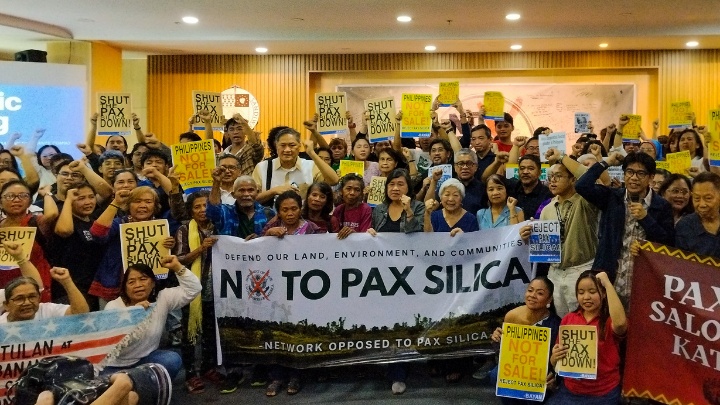
BEING fond of artificial intelligence (AI) among Filipinos doesn’t necessarily mean supporting the idea of establishing an AI data center that would deplete the country’s energy and water resources.
Based on the latest results of a survey administered by the WR Numero Research, seven in every 10 Filipinos rejected the Pax Silica initiative between the Philippines and the United States.
According to the October national survey of WR Numero Research, a subsidiary of WR Advisory Group led by president/CEO Prof. Robin Michael Garcia (Ph.D.) 71 percent of those surveyed opposed the establishment of AI data centers and hubs even after being informed of its potential economic and technological benefits.
The survey data also showed that a huge chunk of the respondents were unfamiliar with Pax Silica, a US-led initiative involving strategic supply chains for advanced technologies, semiconductors and critical minerals, reported Business World.
Initially, 77 percent of the respondents said they would not support the initiative. Only seven percent agreed, the rest are still undecided.
“The findings indicate that the initiative faces both an awareness challenge and a predominantly negative initial response among respondents answering the support question,” WR Numero said on Thursday.
Opposition remained high after respondents were presented with a description of Pax Silica as an agreement intended to boost the country’s technology and semiconductor industries, contribute to economic growth and deepen its relationship with the US.
Following the explanation, 71 percent said they would not support the initiative, while 13 percent changed their mind and hinted at supporting the endeavor. Another 16% remained unsure.
Support increased by six percentage points from the initial measure, while opposition declined by the same margin.
The poll also found that 67 percent of respondents expected Pax Silica to have a negative impact on the Philippines, including 37 percent who anticipated a “very negative” effect and 30 percent expecting a “negative” impact.
Only eight percent expected a positive outcome, while 17 percent anticipated a neutral impact and another 8 percent unsure.
The findings come as the Philippine and US governments pursue negotiations on the initiative’s proposed implementation, which Manila has presented as an opportunity to attract strategic investments, strengthen manufacturing capabilities and expand the country’s participation in advanced technology supply chains.
However, the proposed development has faced opposition from groups citing concerns over land rights, displacement, livelihoods, environmental impacts and the protection of local communities and natural resources.
Protests against the initiative were also held during US President Donald J. Trump’s visit to the Philippines for the 49th Association of Southeast Asian Nations Summit and Related Summits earlier this week.
The October survey was conducted through face-to-face interviews with 1,225 Filipino adults from Oct. 7 to 13. It had a margin of error of ±2.8 percentage points at a 95 percent confidence level.
Numero Research is an independent, non-partisan public opinion research and data analytics firm in the Philippines founded in 2020 based in Ortigas Center, Pasig City. It combines political science, sociology, statistics, and political psychology to analyze Philippine social and political trends. It served as a data and analysis partner for ABS-CBN during the 2025 Philippine midterm elections.