

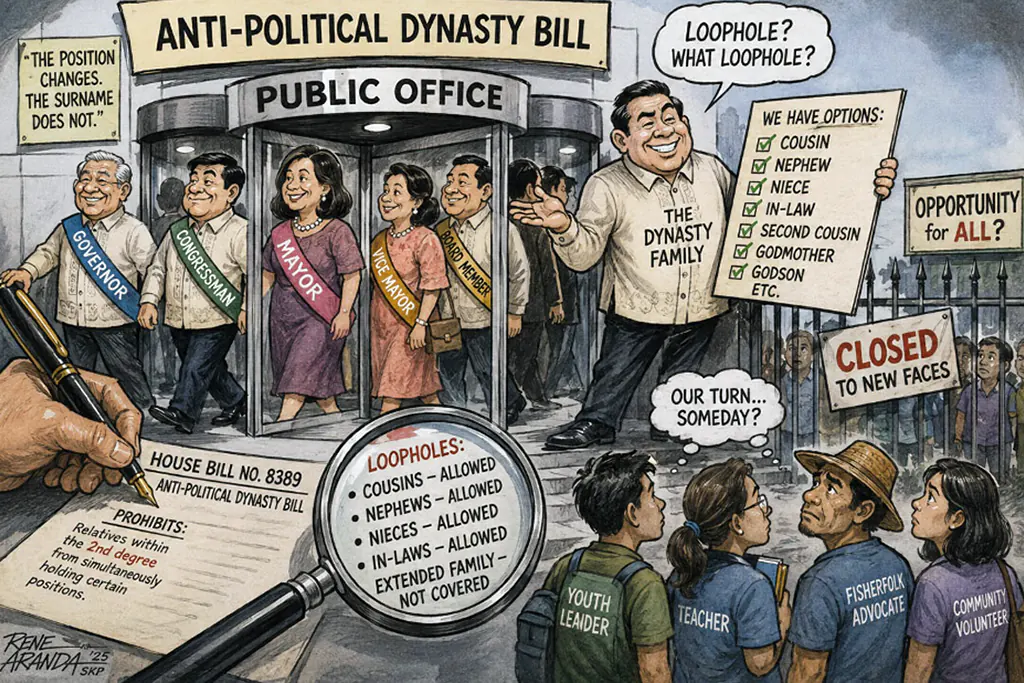
POLITICAL clans are seen to rule the country for an eternity, unless an honest-to-goodness anti-dynasty law is enacted, says retired Supreme Court Justice Antonio Carpio.
In a recent radio interview, Carpio assailed House Bill 8389 jointly filed by House Speaker Faustino Dy III and presidential son Sandro Marcos in his capacity as Ilocos Norte representative.
“Political dynasties will become more entrenched if the House-proposed anti-dynasty bill is approved,” said Carpio in reference to the HB 8389 which bans family members of only up to the second degree of ties from public office.
The bill was “divided into five categories,” with the president, vice president and senators in one category, and congressmen and local positions in separate categories, Carpio explained.
“The father can run for president, the nephew and niece for vice president, and the uncle and auntie for the Senate because that’s outside the second degree,” he pointed out.
The siblings belonging to a family of politicians may seek election in each legislative district in a province or in each town and city, he added.
Carpio maintained, “It will be worse, the political dynasties will be more entrenched,” the Philippine Star quoted him.
According to earlier reports, Dy and Marcos – both of whom belong to old dynasties – proposed that spouses and relatives within the second degree of consanguinity or affinity would be prohibited from simultaneously seeking or holding elective posts within the same political jurisdiction, such as a single province, city, municipality or barangay.
Deputy Speaker Francisco Paolo Ortega V, who belongs to the political dynasty in La Union, defended the measure, saying it was the “most realistic” and would balance the effort to control political power and the democratic right to vote for leaders.
The Dapat Isa Lang Movement, which Carpio is a convenor, had rejected the proposed House bill and maintained the ban on political dynasties should be extended up to the fourth degree, or up to the first cousins, uncles and aunts, nephews and nieces, grandparents and grandchildren and others belonging to four generations of a public official and his or her spouse.
It has since launched an online signature campaign proposing only one member of the family within the fourth degree can run in each national and local position, according to Carpio.
The group has employed the people’s initiative, wherein they have to collect signatures of the constitutionally required three percent of the registered voters in each of the country’s 254 legislative districts or 10 percent of registered voters nationwide, to be able to advance its call for Congress to enact its proposed anti-dynasty law, he explained.
While the group has not set a deadline for the gathering of signatures, Carpio said they may gather signatures up to next year, ahead of the next presidential polls in 2028.
The Supreme Court in its landmark ruling last August has ordered Congress to pass a long overdue anti-dynasty law (after 39 years that it failed to do so) as mandated by the Constitution, which was tantamount to grave abuse of discretion.
The HIgh Tribunal also suggested that the ban on political dynasties must apply to the fourth degree “including half-blood, adoptive, step and common-law relationships, as well as both legitimate and illegitimate filiations.”