

AFTER raking tens of billions in profits, companies behind the onion cartel five years ago were made compensate the government with what looks more like a “loose change” rather than filing a case for economic sabotage.
According to the Philippine Competition Commission (PCC), six companies were meted a combined amount of P1.6 billion in fines for engaging in cartelized operations for onion in 2021-2022, when domestic prices of this vital cooking ingredient leapt to a ridiculous level of P800 per kilogram.
The fine, PCC claimed, is for the illegal supply manipulation to force prices up, and their importation, cold storage and wholesale distribution of red and yellow onion bulbs.
The respondents engaged in anti-competitive agreements involving imported onions, during investigations done from 2020 to 2021, the PCC said.
“We did the investigation. Later on, we discovered there’s this group of companies… We discovered that there are indications of overlapping officers and directors and that’s how we started the investigation,” said Christian Loren delos Reyes, PCC Director for Enforcement Office to ABS-CBN News.
In July 2024, the PCC filed charges against some onion importers for violations of Section 14 of the Philippine Competition Act, which prohibits anti-competitive agreements, including arrangements to divide or share markets.
Following the case, the Department of Agriculture also blacklisted the companies involved.
The commission said it found out that a freight-forwarding company used the credentials of respondent importers, assigned the same importers as consignees, monitored import permit applications and coordinated shipments.
The commission said the respondents controlled nearly 50% of all import clearances for red and yellow onions.
Imported onion shipments were also routed to cold storage facilities managed by one cold storage company.
The facilities involved in the case were located in Bulacan, Iloilo, Cebu, Cagayan de Oro and Davao City, although the alleged scheme affected the onion market nationwide.
“The commission ordered the respondents to permanently cease and desist from carrying out their agreement and pay their respective fines in 15 days from receipt of the decision,” said PCC Executive Director Kenneth Tanate.
Tanate said the fines were calculated using onion wholesale prices reported by the Philippine Statistics Authority (PSA) and the volume of onions involved. The penalties were also tripled because onions are classified as a prime commodity.
The PCC said it would coordinate with the Department of Justice on possible criminal charges.
If the cartel still fails to pay the fines, it could face additional penalties with daily charges accruing to their continued non-compliance, the PCC explained.
The fine, the largest imposed by the PCC under the Philippine Competition Act (PCA), was ordered in a decision issued on October 1, against six respondents found liable for market allocation in the onion import trade, ABS-CBN reported.
Respondents have 15 days from receipt of the decision to pay or file a motion for reconsideration (MR). At the time of the PCC briefing, none had paid, and the deadline was due the following day.
Failure to comply may trigger an additional fine ranging from P60,000 to P2.5 million, plus P55,000 for every day of delay. The daily charges will begin accruing 45 days from the decision’s issuance, the PCC said.
The respondents were also ordered to permanently cease and desist from their agreement, which violated Section 14(b)(2) of the PCA, prohibiting competitors from dividing or allocating markets.
The fines will be remitted to the National Treasury.
“Four importers and their facilitators were each assessed P330 million, while Eric Pabilona, associated with Tian Long Corp., was fined P118.32 million based on his computed turnover.”
The PCC said the computation considered actual onion import volumes covered by sanitary and phytosanitary import clearances (SPSICs), average wholesale prices reported by the Philippine Statistics Authority, relevant turnover, the duration of the infringement and aggravating or mitigating circumstances.
Because onions are a prime commodity, the applicable fine was tripled under Section 41 of the law.
The Cartel Operations
The investigation began in late 2022, when onion prices reached P800 per kilogram in December. The PCC later identified companies with numerous import permits and overlapping officers or directors.
A court-authorized inspection of the respondents’ offices at Goldenshine Corporate Center on September 6, 2023, yielded documents and emails indicating that the companies shared SPSICs and used a coordinator, according to the commission.
The PCC Enforcement Office filed a Statement of Objections on July 10, 2024.
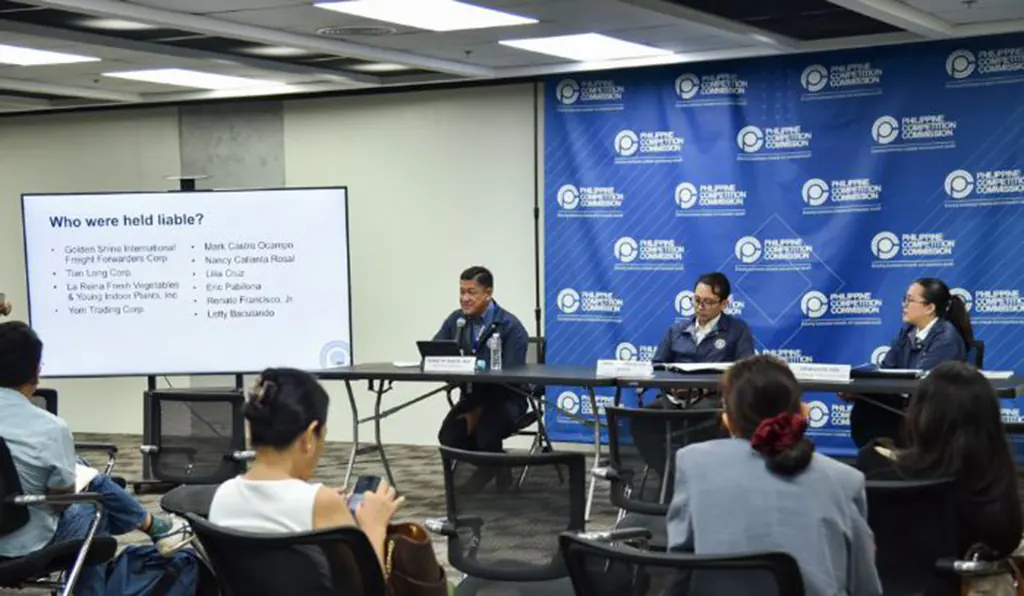
“The final decision named six respondents, including Golden Shine International Freight Forwarders Corp., Tian Long Corp., La Reina Fresh Vegetables & Young Indoor Plants Inc., and Yom Trading, along with associated individuals and sole proprietorships.”
These include Mark Castro Ocampo, Nancy Callanta Rosal, Lilia Cruz, Eric Pabilona, Renato Francisco Jr. and Letty Baculando.
The PCC said Goldenshine coordinated applications, permit allocations and shipments using other importers’ credentials. Through separate corporate entities, the group controlled nearly half of import clearances for red and yellow/ white onions.
Imported onions were stored before distribution across Luzon, the Visayas and Mindanao, including facilities in Bulacan, Iloilo, Cebu, Cagayan de Oro and Davao.
VIEVA Philippines and Philippine VIEVA Group were excluded from the final liability findings because the PCC found insufficient evidence directly linking them to the cartel. Their import licenses had also expired, the agency said.
The PCC failed to investigate current or former agriculture officials who may have caused the release of import permits as the inquiry focused on evidence of coordination among companies.
The administrative ruling is separate from possible criminal proceedings. The PCC said it would coordinate with the Department of Justice to assess whether the evidence supports a criminal complaint. Paying the fine would not automatically resolve any criminal liability.
Respondents may appeal to the Court of Appeals if their motions for reconsideration are denied. However, an appeal does not automatically suspend collection; a restraining order from the appellate court is needed to halt it, the PCC said.