

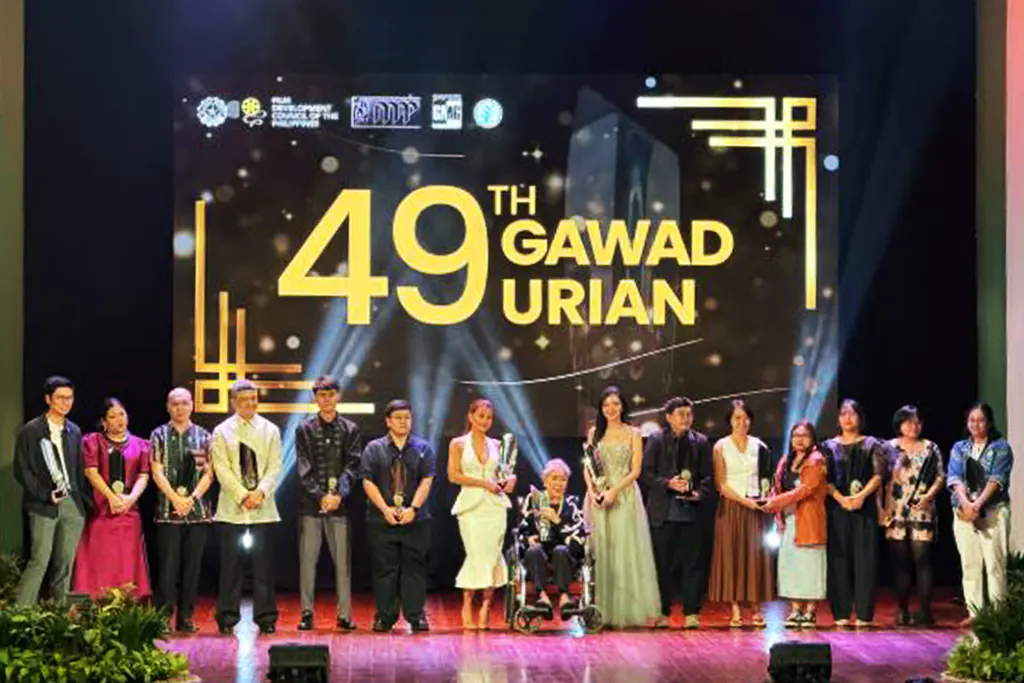
IF it’s Gawad Urian by the Manunuri ng Pelikulang Pilipino (MPP), it must be contrarian.
It was once more manifested in its 49th awards ceremonies recently held at the Teresa Yuchengco Auditorium of the De La Salle University in Taft Avenue, Manila.
While most awarding ceremonies were delayed of TV coverage or live presentation, the 2026 Urian Awards started on the real time dot as advised in the invite.
In the nomination lineup, most of the nominees weren’t big studio stars, creatives and productions, breaking the tradition of major film outfits in the running.
Taripnong Cagayan Valley, Hyperfusion and WAF Studios’ “Bloom Where You Are Planted,” about activism in Cagayan Valley won two major awards, Pinakamahusay na Pelikula (Best Film) and Pinakamahusay na Dokyumentaryo (Best Documentary Film).
It also took home the Pinakamahusay na Direksyon (Best Direction) for Noni Abao and Pinakamahusay na Editing (Best Editing) for Che Tagyamon and Amex Nicolas.
Jericho Rosales who brought home the Pinakamahusay na Aktor (Best Actor) might be a heavyweight star from a major film factory but his platform of winning was from TBA Studios that is sort of playing second fiddle in a celebrated, hyped biopic of a past Philippine president named Manuel Luis Quezon, “Quezon” and Jericho’s tier Carlo Aquino won it from a very independent stakeholder called 901 Studios’ “Bar Boys: After School” whose supporting cast Will Ashley snagged the Pangalawang Pinakamahusay na Aktor (Best Supporting Actor) from the same tentpole.
Pinakamahusay na Aktres (Best Actress) was a stalemate between two significant minor releases from relatively new companies but adequately helmed entries, “Sunshine,” a bold act of an infanticipating gymnast who defied traditions produced by Anima Studios, Project 8 Projects and Cloudy Duck which won for Maris Racal and “Bar Boys: After School,” a highly critical look at the redemptive roles of lawyers and justices in an unjust and inhumane society essayed effectively by Odette Khan.
Meanwhile, Jenina Garcia romped away with the Psngalasanv Pinakamahusay na Aktres (Best Supporting Actress) in “Sunshine.”
Other recognitions were given to lesser known film artists except for some like Jerrold Tarog, Best Music (“Quezon”), Emilio Bien Sparks, Best Sound (“Cinemartyrs”); Best Short Film, “Cemento”; Best Documentary Film, “Bloom Where You Are Planted”; Renei Dimla, Best Screenplay (“Republika ng Pipolipinas”) and Pong Ignacio, Best Cinematography (“Quezon”).
Veteran actor and filmmaker Laurice Guillen was bestowed the Natatanging Gawad Urian (Lifetime Achievement Award).
Time and again, what’s wrong with the perennial Urian ties when the recipients are equally outstanding and substantial in their artistic outputs?
Urian’s awards ceremonies never disappoint as brisk and simple with, at least, one or two musical intermission numbers.
What is more important is the social impact of the awarding and the winners.
From the start, Gawad Urian gives premium to the overall influence of the films that resonate to the Filipino experience.
From its creation in 1976 alone, it has shown a dissenting thrust from the more institutionalized or established award-giving bodies in the country, particularly about deserving productions, to be recognized, which include movie companies, creatives and other technical people in filmmaking.
Eleven visionaries from the media, arts and culture, academe, civil society etc. bonded together to form a critics’ group bound by a common cause of seeing films as a medium for excellence in moviemaking.
The eleven progressive critics were now National Artists, namely Bienvenido Lumbera and Nicanor G. Tiongson, adman Pio de Castro III, entertainment editor in English broadsheet Manny Pichel, bi-lingual magazine and newspaper writer Mario A. Hernando, book author and teacher Petronilo Bn. Daroy, theater artist Behn Cervantes, literary figure Clodualdo del Mundo, Jr., educator and essayist Justino Dormiendo and multimedia person Nestor U. Torre, Jr.
In past interviews with Lumbera, Tiongson, Daroy, Hernando and later recruited members, now National Artist for Film Ricardo Lee, also known as Ricky Lee and short story writer, novelist, poet, essayist and mentor Jun Cruz Reyes (Lee and Reyes didn’t last their MPP membership for conflict of interest for the former because he was already writing screenplays in the late 70s and Reyes purportedly for multiple commitments), they were one in saying that a film is based on society–the creative and administrative functions of it.
First and foremost, that a screen narrative/story comes from a palpable and tangible society (even dreams or outer space etc. are societies) and the movie industry is a society, as well, so the conditions of filmmaking should be considered.
Understanding the limitations of movie producing, generally, in the Philippines, is one of MPP’s prime concerns.
There are mediocre films and potboilers which shouldn’t be looked down but best understood.
Derided or criticized yet in context.
That is why when a well-meaning writer labelled the Manunuris some forty years or so ago as a bunch of deletantes, he was missing the point.