

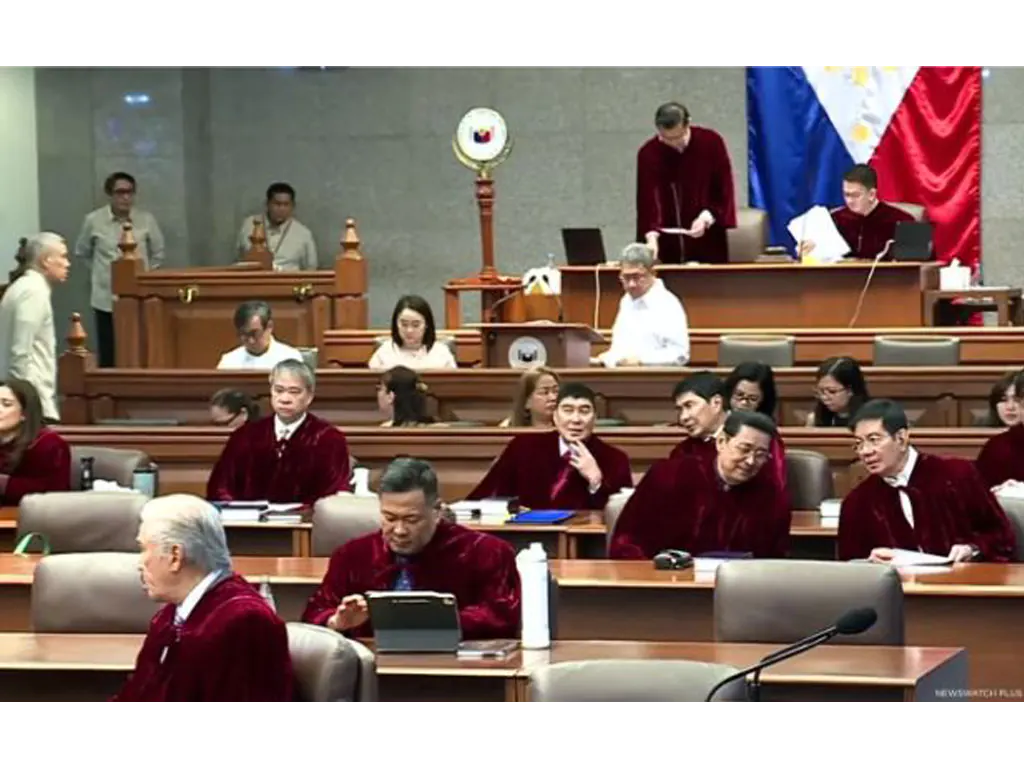
AS the 38th day of impeachment trial against Vice President Sara Duterte continues, more financial mess is being unearthed and her defense team is apparently hard-pressed in proving that the incriminating documents do not prove her guilt.
For how can a banana chip export company, established in 2021, with her husband, lawyer Manases Carpio as the 47.5 percent owner, sell P150 million in 2024 without a single employee, according to a clarificatory question of Senator-judge Joel Villanueva on Monday.
This surfaced as state prosecutors presented their forensic audit expert, Alexander Cabrera who analyzed volumes of bank, tax and other financial records of the Duterte-Carpio couple.
Villanueva, citing the company’s filings with the Securities and Exchange Commission, said Cale88 had no employees in 2023 and 2024 and had two employees in 2025.
He asked Cabrera if, in his analysis of the Duterte-Carpio financial documents, he found an “outsourcing or sub-contracting arrangement” that Cale88 might have entered into that would explain the lack of employees in 2023 and 2024 and the entry of two workers in 2025, to which Cabrera said he found none..
Villanueva also asked about year-end inventories of the banana chips exporter.
“What happened was, at the end of the year, it had no inventory — no bananas, no sugar, no packaging, etc,” he said in Filipino.
Cabrera confirmed the senator’s statement: “That’s right, sir. They only had a small inventory of finished goods, but they didn’t have material supplies or work-in-process inventory,” which would mean a manufacturer has to stop work if no such inventories were present.
“I’s not natural that you don’t have an inventory because that’s part of the materials used for you to export,” Cabrera said.
Villanueva posed the same questions to the defense, but defense counsel Kristine Ferrer said they would tackle the matter when it was their turn to present evidence.
Based on testimonies and documents presented to the Senate impeachment court, Cale88 was effectively a partnership– between Carpio and dentist Lourdes Lebosada with an equal share of 47.5 percent– when it was organized in September 2021.
Between 2022 and 2025, Cale88 received remittances from abroad totaling P776 million, including P319 million from Chinese companies.
In 2025, the business entity reported that it was already majority-owned by a company named Pikimong-Pikimong, the Inquirer reported.
The National Bureau of Investigation meantime is investigating businessman Jaime T. Cruz’s links to companies associated with Vice President Sara Duterte and her brothers, as well as properties they declared that may be worth far more than their reported values.
On Monday, NBI Director Melvin Matibag said the bureau was examining corporate records linking Cruz, a former special envoy to China for trade and investments under then President Rodrigo Duterte, to businesses associated with the Vice President, Davao City Rep. Paolo “Pulong” Duterte, and Davao City Mayor Sebastian “Baste” Duterte.
The investigation comes amid scrutiny of the Duterte family’s declared wealth and allegations that Cale88 Food Corp., a company linked to Sara’s husband, lawyer Manases “Mans” Carpio, received P319.32 million in remittances from Chinese entities.
The NBI is separately investigating the alleged foreign financial support to Cale88 because of its potential national security implications. “What is telling here is there is a Chinese personality here, in the name of Ang Hai Peng, who suddenly disappeared,” Matibag said as he presented to the media the diagram of Cruz’s connections to Duterte-linked businesses.
“He was there in 2013, then suddenly disappeared” without a trace. So again, we are looking into it,” he added.
Matibag said the connections were based on the Duterte family’s declarations and corporate records. He also cited documents indicating a relationship between Cruz and Baste, who had said he knew nothing about the matter.
Cruz was identified during the Vice President’s impeachment trial as an incorporator of several companies in which she declared shareholdings. These include City Hall King Chow Foods Corp., Metro City Chow Foods Corp., Great Jolly Times Foods Corp., Davao New Royal Taipan Foods Corp., Davao Emerging Taipans Corp., and Davao Bounty Times Foods Corp.
The prosecution’s plan to summon Cruz as a witness in its case alleging unexplained wealth against Sara did not push through. Matibag said the NBI was also investigating properties linked to Sara and Paolo after an initial field inspection in Davao City found land declared at about P890,000 that he said could be worth P50 million to P60 million.
The property in Catigan, Davao City, was declared agricultural land, but NBI agents found what appeared to be a resort, with improvements that Matibag said were not reflected in the declaration. “It was declared as agricultural land, but even the neighbors—people from Davao themselves—identified it as the Dutertes’ property,” he said.
Matibag said the bureau consulted an assessor to estimate its value.
“The discrepancies are significant. In Catigan alone, the declared value is only P890,000, but upon consulting an assessor, it is around P60 million,” he said.
Paolo challenged Matibag to present evidence that he owns a property on Samal Island as he warned against publicizing unverified allegations.
“The NBI is an investigative institution, not a platform for trial by publicity,” the Davao lawmaker posted on his Facebook, adding that Matibag should know the difference between a photograph and proof of ownership.
Paolo also questioned Matibag’s credibility, saying allegations of corruption involving the NBI chief had raised concerns for his father, former President Rodrigo Duterte. He urged Matibag to apply the same standards of transparency to reported ghost projects in his wife’s congressional district in Laguna, stressing that “accountability, after all, should not depend on whose name is being mentioned.”
The NBI is examining 24 properties belonging to Sara as part of a broader review of 121 properties attributed to the Duterte family in Davao City and Davao del Norte province, Matibag said.
Matibag said investigators were checking whether money had been converted into real estate, following allegations in an affidavit by former police officer Rodulfo Gracioso Jr. that he delivered suitcases of cash to Duterte family members from 2018 to 2020.
“We are investigating this because we are following the pattern established in the Gracioso affidavit — meaning there was money. Where was the money placed?” Matibag said.
The bureau would refer its initial findings to the Department of Justice and the Office of the Ombudsman, he added.
Gracioso, a former aide to then Speaker Lord Allan Velasco, alleged that he delivered more than P2 billion to Sara, P1 billion to Rodrigo Duterte and P100 million to Paolo in installments on Velasco’s instructions. The allegations have not been established as fact.
His lawyer, Peter Paul Danao, said on Monday he had submitted an affidavit on the congressman’s behalf denying the accusations while preserving his legal objections to the bureau’s jurisdiction.
Danao called Gracioso’s claims “fairy tale concoctions” and said the filing of an affidavit ad cautelam, or a precautionary sworn statement, did not mean Paolo had conceded the NBI’s authority to proceed.
He urged investigators to conduct an independent and impartial inquiry free from political pressure.
VP Duterte meantime lambasted President Marcos Jr.’ warning that allegations of Chinese entities funding a company linked to her husband could pose a threat to the country “at the highest level” if proven true.
Speaking on the sidelines of OVP’s 91st anniversary, Sara said the remarks suggested that the Marcos administration had considered her a threat since 2023.
“It’s like he is saying that those engaged in business or trade with China are also a threat to the country,” she said, noting that many Philippine businesses import from or export to China.
Marcos made the remarks Sunday during a working visit to Singapore, saying the allegations were being thoroughly investigated and that he would welcome evidence disproving them.
At the trial, Sen. Risa Hontiveros cited records showing that companies remitted P319.32 million to Cale88. Carpio was identified as the company’s incorporator, stockholder, and board member. Hontiveros said open-source research by her office identified China National Township Enterprises and Beijing ZhenweiFang Food Company as having ties to the Chinese government and Chinese Communist Party organizations.
Anti-Money Laundering Council Executive Director Ronel Buenaventura testified that the money went to Cale88, not directly to Sara or Carpio. He said it had not been established that the funds came from the Chinese government and that the transactions did not prove illegal wealth or cash holdings directly tied to the couple.
Matibag said the NBI had established a unit to investigate foreign malign influence and would examine the transactions.
In a related development, Senator-Judge Francis “Kiko” Pangilinan questioned the timing of P41 million in cash withdrawals made by lawyer Mans Carpio on Aug. 6, 2024, six days after drug-related charges were filed against him and weeks after his wife, VP Sara resigned as education secretary.
During the 38th day of Duterte’s impeachment trial, Pangilinan said that Duterte resigned as Department of Education secretary on July 19, 2024, while charges against Carpio in connection with the alleged magnetic lifter incident were filed on July 30.
Based on Cabrera’s report, Carpio withdrew the P41 million within approximately one hour and 13 minutes. “I became curious about what happened on August 6, or where they were at the time,” Pangilinan said. Cabrera confirmed that the accounts involved belonged to Carpio.
Earlier, Cabrera told Senator-Judge Risa Hontiveros that the transactions appeared unusual because withdrawals resumed immediately after a lunch break.
“It seemed as though there was some urgency because the transactions continued immediately after lunch. It also takes considerable time to count P41 million in cash,” Cabrera said.
He added that large cash transactions and gaps in documentation could raise red flags in a forensic investigation, but did not establish that the withdrawals themselves constituted wrongdoing.
Pangilinan also questioned the ownership of Cale88, whose 2025 records indicated that Carpio had transferred his shares to Pikimong Pikimong Philippines Corp.
Cabrera said the forensic team continued to consider Carpio the owner because it found no documentation establishing that the shares had been transferred.
The team examined corporate records filed with the Securities and Exchange Commission (SEC), he said, describing Pikimong Pikimong as a shell company.
Cabrera said the company had only two shareholders and reported equity of P56,000 in 2024. Its reported assets in 2025 amounted to P86,000.
He said the records showed no transactions or disclosures establishing that Pikimong Pikimong had purchased Carpio’s shares in Cale88.
“Because there is no record of the transfer, the official records prevail,” he said.
Pangilinan questioned how a company with such limited reported capital could acquire an interest in Cale88, which recorded substantial financial inflows.
Cabrera clarified that the prosecution’s report identified approximately P222 million in relevant remittances, while about P319 million referred to amounts flagged in Anti-Money Laundering Council (AMLC) records.
He said the team could not establish the funds’ ultimate destination.
Pangilinan also questioned the repeated conversion of cash into managers’ checks, including checks issued in Carpio’s name. Cabrera said he had not previously encountered such a pattern in his professional work.
He explained that converting cash into a manager’s check does not eliminate the obligation to declare the amount in a Statement of Assets, Liabilities, and Net Worth (SALN).
“If the cash is no longer declared, the receivable should be declared instead,” Cabrera said.
He identified P96 million in managers’ checks, comprising P41 million and P55 million in transactions, which he said should have been reflected as receivables in the relevant SALNs.
Pangilinan also examined Cabrera’s findings on GenCorp, which reportedly grew from approximately P28 million in revenue in 2021 to more than P520 million in 2025, despite reporting paid-in capital of only P1.25 million.
Cabrera said the company’s financial statements did not clearly explain the source of the funds supporting its growth and acquisitions.
He explained that funds entering a business would ordinarily be expected to finance operations, equipment, inventory, employee salaries or debt payments.
When money moves into and out of a company without apparently adding economic value, the pattern can raise concerns, he said.