

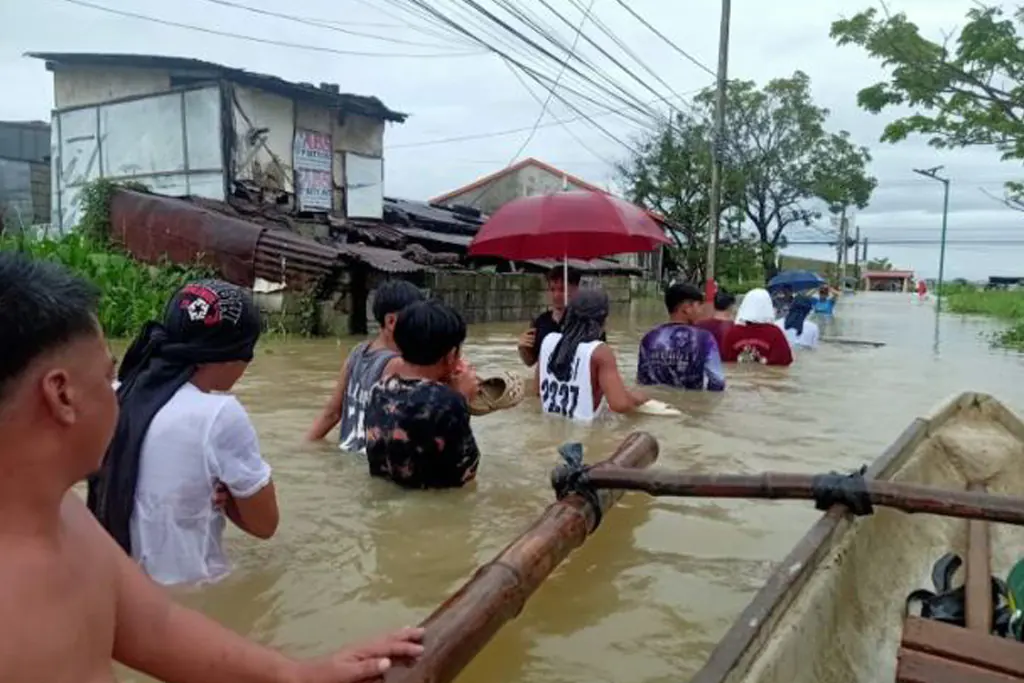
VEERING away from the usual concrete structures in addressing flooding in low-lying areas of Bulacan, the Department of Public Works and Highways is working with the Asian Development to adopt “green-gray” strategies across major river basins (such as restoring wetlands in Tagum-Libuganon and mangrove buffers in Buayan-Malungon) and pioneering coastal bamboo breakwaters in Bulacan.
DPWH Secretary Vivencio Dizon said over the weekend that the government was shifting away from its traditional reliance on concrete structures to nature-based solutions to address chronic flooding in Bulacan.
Dizon explained that DPWH had for decades tended to turn to concrete structures such as sheet piles, concrete dikes and other engineering works whenever flooding occurred.
“We need to change that,” Dizon was quoted as saying in a report published by the Manila Times.
He said that flood-control planning must consider how the natural environment could be used to reduce the effects of flooding instead of relying almost exclusively on concrete infrastructure.
“Nature cannot simply be addressed through engineering or concrete. We need to think about how nature can help protect us against the negative effects of nature itself,” he explained.
Dizon cited ongoing work in Malolos, where he inspected infrastructure projects earlier this week, as a pilot for the approach, saying its effects were already being observed after about a year.
The government should accelerate the implementation of such projects and increase national government investment in nature-based flood-control measures, he stressed.
The top DPWH official also questioned the agency’s traditional preference for concrete dikes, saying alternatives such as earth-based structures should be considered.
He cited the experience of Dutch consultants working with the government, saying the Netherlands uses nature-based solutions for more than half of its flood-management measures despite being a wealthy country.
“In our country, everything is concrete,” Dizon averred.
He said concrete structures could deteriorate and suggested that the government’s approach to flood control should change.
Dizon also hinted that the DPWH may begin with the Malolos pilot as a model for a wider flood-control program covering communities around Manila Bay in Bulacan and neighboring Pampanga.
He identified the towns of Hagonoy and Paombong in Bulacan and towns of Masantol, Macabebe and Sasmuan in Pampanga as among the areas where similar solutions could be pursued.
The initiative, he said, would build on the experience of Malolos Mayor Christian Natividad, with whom Dizon met two weeks prior to discuss measures addressing the province’s recurring flooding.
Dizon said the government needed to act more quickly because residents in Bulacan had been experiencing flooding year after year.
“The people are suffering,” and the government must act on the province’s long-running flood problem, he said.
Nature-based solutions (NbS) for floods use natural ecosystems and processes to slow down, store, and absorb excess water instead of relying solely on hard-engineered structures like concrete seawalls or high dikes.
Among the nature-based solutions to flood are:
- Wetland Restoration: Reconnecting rivers to natural floodplains and wetlands allows floodwaters to spread out safely and slowly rather than rushing downstream.
- Mangrove and Coastal Re-greening: Planting and protecting mangroves, bamboo breakwaters, and salt marshes absorb storm surges and reduce wave energy along coastlines.
- Reforestation and Afforestation: Planting trees on hillsides and watersheds stabilizes soil, prevents landslides, and absorbs heavy rainfall before it reaches rivers.
- River Re-meandering: Removing artificial straight channels and letting rivers curve naturally slows water velocity and reduces downstream erosion.
- Water Retention Ponds: Creating shallow basins or engineered green spaces temporarily holds urban runoff during intense storms.
The Netherlands, famous for its large-scale “Room for the River” program, which gave rivers more space by moving dikes back, digging side channels and creating flood-storage islands, is among the country’s consistently adopting nature-based solutions.
Sri Lanka, through its urban wetland restoration in Colombo to naturally absorb and store heavy monsoon rainfall, is another.
Indonesia is restoring damaged coastlines and mangroves using permeable brushwood dams in Demak to trap sediment and rebuild natural sea defenses.
Vietnam is investing heavily in mangrove forest rehabilitation along coastal zones to protect vulnerable communities from typhoons and sea-level rise.
Lao PDR implements ecosystem-based adaptation projects—like cascading weirs and retention ponds—to slow down water flow in provinces like Savannakhet.