

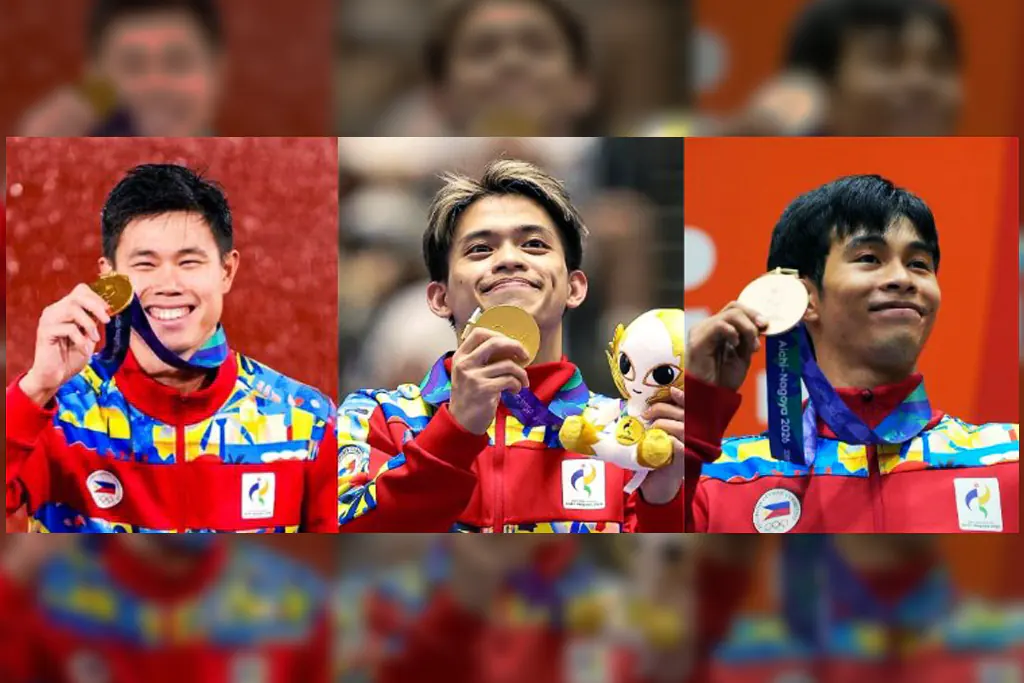
LOCAL athletes forming part of the Team Philippines fell short of its eight-gold target at the Aichi-Nagoya Asian Games, but returned home with a 29-medal haul, its best overall showing in more than six decades.
The Philippines finished with four golds, nine silvers and 16 bronzes, matching its four-gold output from Hangzhou while substantially improving its overall medal haul. The Philippine Sports Commission described the performance as the country’s best since the 1962 Jakarta Games.
Carlos Yulo led the golden charge with victories in the men’s floor exercise and vault. EJ Obiena retained his pole vault crown with an Asian Games-record 5.91 meters, while Jeus Gabriel Derick Yape added gold in virtual taekwondo.
The silver medalists included Carlo Paalam, Amaya Amparo Cojuangco, Jean Claude Saclag, Alexandria Enriquez and several other members of the national team.
The 16 bronze medalists were Eldrew Yulo, Albert Ian Delos Santos, Carlos Alvarez, Marie June Adriano, John Cabang Tolentino, Victoria Bossong, Alexandra Eala, Jayuard Alciso, Kaila Napolis and Jeus Yape, plus the Philippine women’s soft tennis team, women’s karate kata team, men’s sepak takraw regu, women’s beach volleyball pair and the two SIBOL esports squads in Pokémon UNITE and Honor of Kings.
Under Republic Act No. 10699, individual Asian Games bronze medalists receive P400,000 from the government. Thus, Yulo’s bronze-winning brother Eldrew, Delos Santos, Alvarez, Adriano, Cabang, Bossong, Eala, Alciso, Napolis and Yape are each entitled to P400,000 for their individual bronze medals.
For teams, the law provides different rates. Members of teams with five or more athletes receive 25% of the individual medal incentive, or P100,000 each for bronze, while teams with fewer than five members share the applicable individual incentive.
Yape, meanwhile, stands to receive P2.4 million from the government — P2 million for his virtual taekwondo gold and P400,000 for his individual poomsae bronze. Yulo tops the individual payday with P4 million for his two gold medals, while Obiena gets P2 million.
The eight-gold target may have slipped away, but the 29-medal haul gives Philippine sports a stronger platform — and a new benchmark to chase when the next Asian Games come around.